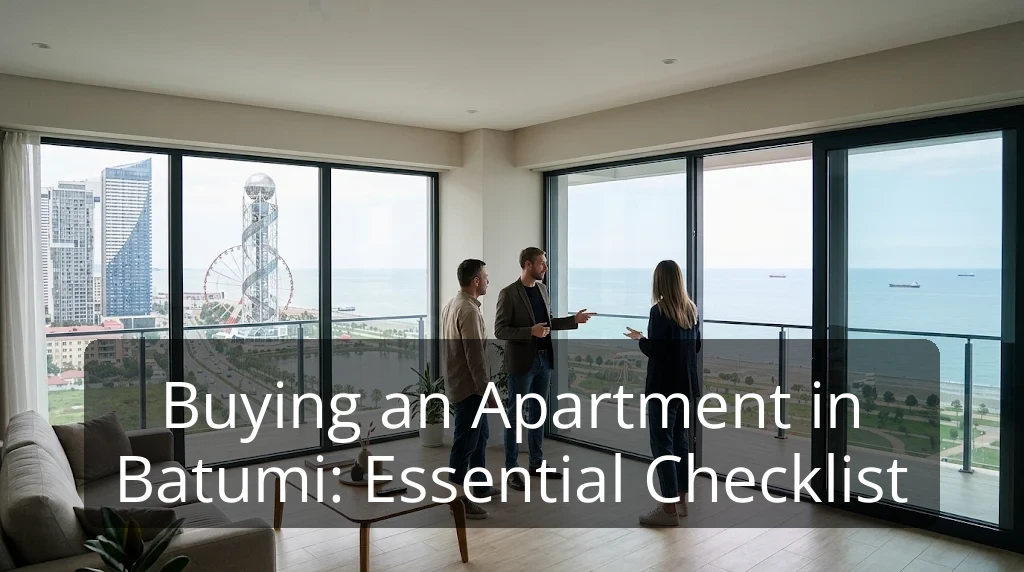

A developer’s brochure shows what it intends to build. Its earlier buildings show what it has actually delivered, and on what timetable. Most Georgian buyers pay a reservation fee before comparing the two, usually because the sales office presents one without the other. This guide gives you a repeatable method for reconstructing a developer’s real history and tying it to the exact company that will sign your contract.
To check a property developer in Georgia, verify the contracting company through the National Agency of Public Registry, examine its completed projects and commissioning records, and compare promised versus actual delivery dates. Check land ownership, mortgages, construction permits, financial warning signs and buyer complaints. Before paying a deposit, have an independent lawyer review the documents and contract.

What Does a Developer’s Track Record Actually Prove?
A developer’s verifiable track record is the documented history of what a specific legal entity promised, built, commissioned, registered and handed over to buyers, together with how it handled defects afterwards. A long operating history, an impressive portfolio and positive reviews do not show that the company signing your contract has done any of this. This section is for buyers comparing developers before a reservation payment or preliminary contract. The research supports three decisions: whether to proceed to legal review, which documents to demand first, and which contract protections to insist on.
Developer history and project-specific due diligence answer different questions. History asks whether this group has delivered before. Project due diligence asks whether this plot, permit, contract and seller are sound today. A strong answer to one does not replace the other, and past performance is informative but never a guarantee, because financing, management and market conditions change between projects.
Brand reputation is what the market says about a name. A track record is what documents show about a company. The two diverge more often than buyers expect: a well-known brand may sell each building through a new project company, and a little-known developer may have delivered several buildings on schedule. Company age is similarly weak evidence, because a ten-year-old company may have built nothing in the last six years. Treat reputation as a prompt for questions, not as an answer.
In practice the evidence you want falls into five groups: a list of completed buildings with addresses, cadastral codes and the legal entity responsible for each; dated marketing material stating the promised completion date; construction permits and commissioning acts; registry extracts showing that individual apartments were registered to buyers; and records of defect complaints and how they were resolved. The seven steps below show how to collect and test each group, in this order: legal entity, delivery history, commissioning and unit registration, land and permits, financing and disputes, site visits and owner interviews, and finally the draft contract.
Step 1: Identify the Developer’s Legal Entity
The contracting seller is your primary contractual counterparty, but other parties may have enforceable obligations if the documents or applicable law establish them. Identify the seller before anything else. Take the exact registered name and identification code from the draft agreement, not from the website or the sales presentation. Then obtain information from the Registry of Entrepreneurs and Non-Entrepreneurial Legal Entities maintained by the National Agency of Public Registry (NAPR).

Review the registration date, legal status, listed representatives, partners, recorded changes and any registered restrictions, subject to what the registry makes available for that company (as of November 2026). Confirm that the person signing has authority to bind the company.
Five different parties often hide behind one project name, and each carries a different risk:
| Party | Documentary evidence | Risk if mismatched |
|---|---|---|
| Group brand | Website, brochures, advertising | A brand has no legal obligations; a buyer cannot sue a logo. |
| Project-specific LLC (contracting seller) | NAPR registry information; draft contract | A newly formed company may have no delivery history of its own. |
| Landowner | Real estate extract by cadastral code | The seller may not own or control the land it is selling on. |
| Building contractor | Construction contract or permit documents, if disclosed | Delays and defects may sit with a contractor the buyer cannot claim against. |
| Payment recipient | Bank details in the contract and invoices | Money paid to an unrelated account may not be treated as a payment to the seller. |
A project-specific company does not automatically inherit its parent’s track record. If earlier buildings were sold by other LLCs, the delivery history belongs to those entities unless documents show common ownership, management and responsibility. Assigning the group’s good record to a new LLC is the most common attribution error.
A new LLC is not automatically suspicious. Single-purpose companies are a normal way to ring-fence a project. What matters is whether you can trace who stands behind it and what ties it to earlier delivery. Where the link cannot be shown, treat the parent’s history as unproven for this contract and ask whether the parent will give a written guarantee or other undertaking. Have an independent lawyer judge whether that undertaking is enforceable.
Step 2: Verify Completed Projects and Delivery Dates
This step carries the most weight in the whole process. The goal is a dated timeline for each earlier building, built from documents rather than from the developer’s summary. Here is a method you can reproduce.
- Select earlier buildings to sample. I suggest at least three, if that many exist, including the oldest, the largest and the most recent, not only the showcase project. Three is a practical editorial sampling recommendation, not a legal requirement or a statistically validated threshold.
- Establish the developer’s actual role in each: seller, landowner, contractor or marketing brand. Match each building to a legal entity using contracts, permits and registry information.
- Find the original promise. Look for dated brochures, archived announcements, early contract templates or sales messages that state a completion date. Record the date and where you found it.
- Find documented actual milestones: permit date, construction stages where evidenced, commissioning act date and the date the first unit was registered to a buyer.
- Interview owners about their actual move-in and handover dates.
- Record the variance and your confidence level for each building, then compare across buildings.
Record the results in a table like the one below. The values are hypothetical and illustrate the method only; they are not real developer data.
| Project (hypothetical) | Responsible entity | Original promised date | Verified milestone date | Variance (months and days) | Source | Confidence |
|---|---|---|---|---|---|---|
| Building A | Hypothetical Entity A LLC | 30 June 2018 | Commissioning act: 20 December 2018 | 5 months 20 days (173 days) | Archived brochure; copy of act | High |
| Building B | Hypothetical Entity B LLC | 31 December 2020 | Commissioning act: 28 July 2022 | 18 months 28 days (574 days) | Archived announcement; copy of act | Medium (promise from a single source) |
| Building C | Hypothetical Entity C LLC | Unknown | Owners report moving in around 2021 | Not calculable | Owner interviews only | Low |
How to calculate delivery variance
Delivery variance is the time between the original promised date and the verified date of the same milestone. The convention used in the table is completed calendar months plus remaining days, with the exact day count alongside. No rounding is applied, which matters when you compare against a contractual long-stop date. A positive result means late. Compare like with like: a promised completion date should be set against the commissioning act date, and a promised handover date against the documented handover. Mixing the two makes a developer look better or worse than the documents support.
How many completed buildings are enough to assess?
Three buildings give a basic pattern; five or more give a better one. One building proves little, because a single project can be an outlier in either direction. A developer with fewer completed projects can still be assessed, but confidence in its history is necessarily lower, so say so plainly in your notes: the result is limited evidence, not a pass. Where possible, separate delays the documents attribute to the developer from those caused by a contractor or an authority.
Why marketing completion dates are not proof
A marketing date records an intention, and a marketing “completed” label records a sales claim. Neither shows that a commissioning act exists or that buyers received their keys and registered ownership.
When evidence is missing, mark the field unknown. Never assume on-time delivery because the developer cannot produce a document. A gap is information, and a developer who has delivered well usually has no reason to withhold dates.
The mistake I see buyers make most often: they accept a portfolio page as a delivery record. The page lists buildings, but it rarely shows which company built them, when they were promised, or when owners actually got their keys.
Step 3: Check Commissioning and Property Registration
A commissioning act is the formal record that a completed building has been accepted for use under the construction regime. It is stronger evidence than a finished façade, but it does not prove everything. It does not show that your unit is registered, that the land rights are clean, or that the finishing matches your contract.
Three states are often confused. Formal completion means the building passed the commissioning process. Occupation means people live there. Registrable ownership means an individual apartment can be identified and registered in the public registry. Only the last gives a buyer a registered right.
The legal anchors are these. Article 183 of the Civil Code of Georgia links acquisition of ownership of immovable property to registration, so a contractual promise to transfer a flat is different from a registered ownership right. Commissioning is governed by the Code of Georgia on Spatial Planning, Architectural and Construction Activities, in particular Articles 139 and 139-1.
Article 139 distinguishes construction classes. Class I structures are treated differently and are not subject to recognition as suitable for commissioning, while the commissioning rules for Classes II to IV are set by government legislation. A residential development must therefore be assessed according to its permit classification, its permit date and any transitional provisions. Article 139-1 restricts the operation of a structure, and the supply of electricity or gas to it, before commissioning, subject to defined exceptions such as supply for construction activities.
The practical consequence is that occupied flats or visible utility connections do not establish lawful commissioning. Premature occupation is not an ordinary compliant alternative to a commissioning act; treat it as a question to put to the developer and your lawyer. Texts on Matsne are consolidated versions, so confirm that the version you read matches the relevant legal date, and have your lawyer confirm the position for the specific building (legal framework as of November 2026).
| Document or record | Authority or source | Verification question |
|---|---|---|
| Construction permit of the earlier building | Competent municipal authority | Was the building built under a valid permit, and does the permit holder match the developer entity? |
| Commissioning act | Competent authority; copy from developer | Is the act dated, issued for the correct address and project class, and not for a different phase? |
| Real estate extract for the building plot | NAPR, by cadastral code | Does the record match the permit area and show a legal basis for the developer’s rights? |
| Real estate extracts for individual apartments | NAPR, by unit cadastral code | Are apartments registered to individual buyers, and when? |
| Utility connection records | Utility providers; residents | Do connections support, but never replace, the commissioning evidence? |
A cadastral code identifies a registered object and lets you order its extract. The extract shows the registered owner, rights and recorded restrictions; it does not show whether the building was built legally or whether the construction is complete. Where an earlier building has occupied flats but no registered units, raise it with your lawyer before proceeding.
Step 4: Review Land Rights and Building Permits
Land rights and permits describe the project you are about to buy, not the developer’s past. They still belong in a track-record audit, because a developer with a clean history can have a problem on the current plot.
- Order a fresh real estate extract by cadastral code for the plot. Check the registered owner, the land-use category where applicable, registered rights, mortgages, seizures and other restrictions. Order it close to payment, not weeks before.
- Compare the owner with the seller. A contracting company may not own the land outright. It may hold the land under a development arrangement with the owner. That can be legitimate, but the arrangement and the owner’s consent should be documented and reviewed by your lawyer.
- Request the construction permit, approved plans and any amendments. The permit, not the brochure, defines what may be built.
- Compare footprint, floors, area and intended use against the advertised development. Differences in floors, unit count or use category need explanation.
- Distinguish this permit from earlier ones. Permission for the current project says nothing about whether earlier buildings were completed.
Hypothetical illustration: a brochure advertises a 16-floor tower, while the permit supplied on request approves 12 floors. The gap could be a pending amendment, an older permit version or a marketing error. Until the applicable approved amendment has been independently verified, withhold payment and any binding commitment for units on the additional floors. Ask your lawyer to establish whether the marketed unit is legally authorised under the current permit documentation. The absence of a verified amendment is a reason to pause; it is not, by itself, proof of illegality.
In my view, the first question to put to a sales office is “may I see the permit and the approved plans?” before discussing price. How quickly and how completely it is answered tells you a good deal.
A mortgage on the plot does not automatically signal fraud. Developers commonly finance land or construction with bank loans. The relevant questions are which lender holds the mortgage, how the buyer’s unit will be released on registration, and whether the amount and priority leave room for that release. Equally, a valid permit does not guarantee completion; it only authorises construction. A developer with repeated permit amendments or restrictions on earlier plots deserves closer questions.
Step 5: Investigate Financing, Disputes and Warning Signs
Financial strength is the hardest part of a developer to verify from outside. The task is to separate three things that are often blended in sales conversations: independently verified information, claims made by the seller, and protections that are actually enforceable.
- Independently verified information includes registry extracts, recorded mortgages and restrictions, and permit records. Treat these as stronger than anything said verbally.
- Developer disclosure covers the construction funding plan, lenders, mortgage-release arrangements and how far completion depends on buyers’ instalments. Ask for these in writing.
- Corporate financial statements may be available for some companies through Georgia’s official financial-reporting system, the reporting portal run by the Service for Accounting, Reporting and Auditing Supervision (SARAS). Filing obligations and public availability vary by entity and reporting category, so a missing statement may mean the company was not required to file or the statement is not public. Do not infer solvency, or insolvency, from the existence or absence of statements alone.
- Disputes and insolvency indicators can sometimes be checked through court records and insolvency-related information where lawfully accessible. Search by the company’s identification code, not just its name, to avoid mistaken identity.
- Sales assurances such as “we are well funded” or “the bank supports us” are claims until documents support them.
Absence of a public dispute does not mean absence of financial risk. Court records may be incomplete, searchable only in part, or in Georgian, and a company can run into difficulty without any public case.
From a corporate-finance background, I would add one practical test: ask how much of the remaining construction cost is covered by funds already in hand rather than by future buyer instalments. A developer who can answer that in writing is easier to assess than one who changes the subject.
What a bank mortgage means for the buyer
A bank mortgage on the project means a lender has a registered claim on the land or building. That may indicate that a bank has assessed the project, which is a point in its favour, but it also means the bank’s rights rank ahead of yours in the event of default. Ask who the lender is, whether the lender must consent to unit sales, and how the mortgage will be released or reduced as units are transferred. A mortgage (a secured loan), a seizure and a prohibition on disposal have different consequences, and the extract will show which applies.
How to evaluate public claims about financial strength
- Ask which statements can be backed by documents and which are opinion.
- Be cautious with figures about “sold units” or “construction progress” unless a source can be identified.
- Compare bank-financed and buyer-funded construction without presuming either is safer. Bank finance adds a lender with its own priority claims; buyer-funded construction ties progress to continued sales.
- Ask what happens to your instalments if construction stops, and whether any protection (escrow, guarantee or preliminary-right registration) applies to your purchase. Do not assume any of these is automatic; your lawyer must confirm what can be registered and enforced.
Step 6: Inspect Previous Buildings and Speak to Owners
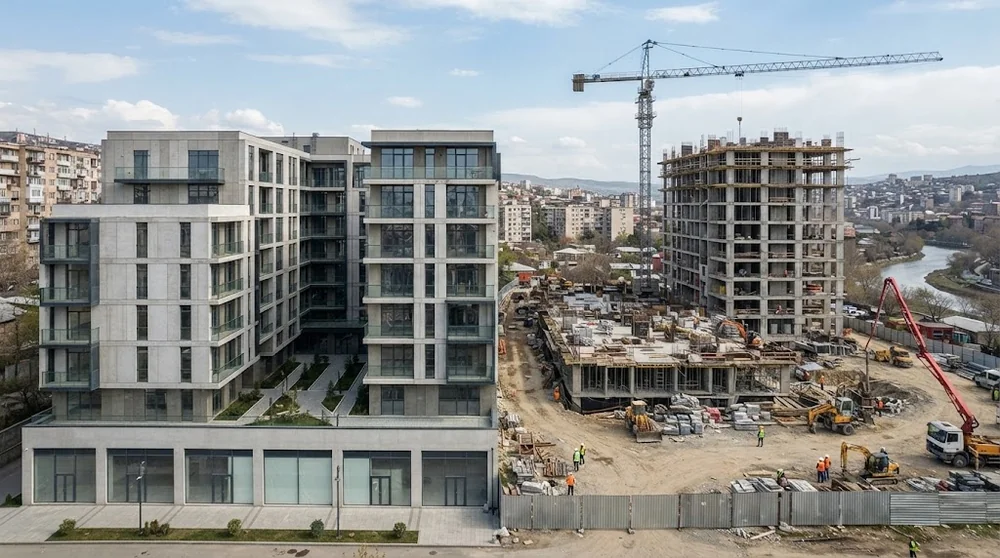
Documents tell you whether a building was completed. A site visit tells you how it has aged. Visit at least one earlier building, preferably two or three built at different times, and record everything with dates.
Use this checklist for visual observations:
- Façade and cladding: cracks, staining, loose panels, sealant failure.
- Roof and drainage: ponding, damaged waterproofing, blocked gutters, damp marks on top-floor ceilings.
- Water ingress: stains, mould or peeling paint in stairwells, basements and car parks.
- Lifts: condition, service stickers, reported breakdowns.
- Communal services: lighting, entrance doors, intercom, water pumps, waste areas, cleanliness.
- Fire-safety provisions: visible signage, extinguishers and access routes; ask whether documentation exists, where available.
- Finishing quality: joinery, tiling, window seals and floor levels in any apartment you are allowed to see.
- Maintenance: who manages the building, what service charges apply, and whether common-area faults are being repaired.
Visual observations are not technical conclusions. Cracks, damp or lift problems may have simple causes or serious ones, and only a qualified building engineer can say which. Commission one if your shortlist is serious.
Speak to several owners or resident representatives, not one. Ask for the actual move-in date, whether the apartment was registered, which defects remain unresolved, what management charges they pay and how the developer responded to complaints after handover. Post-handover accountability is a core part of the record: a developer that fixes defects promptly is showing something a brochure cannot.
Anonymous online reviews are a starting point, not evidence. Corroborate any allegation with at least two independent sources, such as residents who can be named to you privately, written correspondence or photographs with dates. Keep your own photographs with the visit date, store copies of any correspondence, and note who told you what.
Step 7: Match Past Performance to Your Contract
Your findings from Steps 1 to 6 should shape the contract you sign. If earlier projects ran late, the delay clause matters more. If unit registration was slow, the registration clause matters more. The table below lists the provisions to examine and the questions to put to an independent Georgian property lawyer.
| Provision | Why it matters | Risk | Question for your lawyer |
|---|---|---|---|
| Legal identity of seller | The named seller is your primary counterparty | Contract signed with a company different from the project owner | Does the signatory match NAPR information, and does the seller have the right to sell? |
| Unit identification | Determines what you are buying | Vague unit, floor or area description | Are the unit number, floor, area and cadastral reference (or plot reference, for an off-plan unit) stated and consistent with the permit? |
| Completion and handover dates | Fixes the timetable you will compare to history | Dates linked to “approximate” or “expected” language | Are dates binding, and what is the long-stop date? |
| Commissioning | Links handover to formal completion | Handover before a commissioning act | Is delivery conditional on the commissioning act? |
| Specification and frame level | Defines finishing and what is included | Disputes over “white frame” versus “black frame” and materials | Is the specification in the contract or only in a brochure? |
| Payment milestones | Ties money to construction stages | Payments front-loaded relative to progress | Are stages verifiable, and who certifies them? |
| Delay penalties and extensions | Sets the remedy for lateness | Extensions that the developer can invoke at will | What triggers an extension, and is there a cap? |
| Force majeure | Defines excused delays | Broad definitions that cover ordinary construction risks | Which events are listed, and what notice is required? |
| Refund and termination | Governs your exit | Refund limited, delayed or conditional | When can I terminate, and are all sums refundable with interest? |
| Mortgage release | Ensures your unit is free of the developer’s debt | Unit transferred subject to the bank’s claim | How and when will the lender release the unit? |
| Registration of ownership | Creates the registered right under Article 183 | Handover without registration | Who bears the registration steps and cost, and by when? |
| Defects and warranty | Sets after-sales accountability | Short or unclear defect period | What is the defect-notification period, and how are repairs enforced? |
Here’s the clause I always look for: a provision that ties handover to a commissioning act and to the ability to register your individual unit, with a fixed long-stop date after which you can terminate and recover what you paid. I am describing the type of clause to seek, not quoting a clause from any actual contract.
A clause is only useful if it is enforceable and the developer can actually pay. Enforceability depends on Georgian law, the wording and the facts, so a lawyer must assess it. Milestone-based payments reduce how much you have paid at any point, but they do not eliminate insolvency risk. Match the contract to what history suggests: a developer with a record of 15-plus-month delays needs a tighter long-stop and a clearer refund path than one with a record of small variances.
If you want a second view on how a draft agreement handles delay, mortgage release and registration, a short one-to-one conversation can clarify which questions to bring to your independent lawyer.
Whatever you decide about the contract, keep the evidence you gathered in Steps 1 to 6 alongside it, because those documents are what you will rely on if the developer’s performance ever becomes a dispute.
Developer Checks in Tbilisi, Batumi, Gonio and Kvariati
Verification routes differ by location because permitting and project information sit with different municipal bodies. Never assume that every coastal project follows the same procedure; confirm the competent authority for the specific plot first.

| Location | Likely competent authority for permit information | Verification points |
|---|---|---|
| Tbilisi | Tbilisi City Hall, through its architecture service | Permit, approved plans, commissioning evidence; confirm which office holds the file for the specific project. |
| Batumi | Batumi City Hall; Adjara regional bodies may also be involved | Confirm the competent body for the plot, permit class and any regional approvals. |
| Gonio | Falls within Batumi’s Gonio-Kvariati municipal administrative unit, as listed in Batumi City Hall’s service-centre structure; the body responsible for a given permit must still be identified | Identify the responsible authority by cadastral parcel, construction class and applicable rules. A municipal service centre does not necessarily issue construction permits, so ask which body holds the file. |
| Kvariati | Falls within the same Gonio-Kvariati administrative unit of Batumi; the issuing body for a given permit must still be identified | Same check by cadastral parcel, class and rules; also confirm land-use category and any specialist approvals. |
The administrative position for Gonio and Kvariati is documented on Batumi City Hall’s administrative-units page (information as of November 2026). It tells you where to start asking, not who signed a particular permit.
Do not assume an online portal exists or that a service is available electronically. Ask the authority which route applies, and have your lawyer confirm in writing what was requested and received (information as of November 2026; procedures change). In my experience, asking for the permit file by cadastral code, rather than by project name, avoids a lot of back-and-forth between offices.
Resort-style coastal projects raise questions that city apartments usually do not:
- Unit classification: is the unit registered as a residential apartment, or under another category linked to hotel-style operation?
- Operation and management: who operates the building, under what agreement, and for how long? Treat promises of rental-management services as claims until a signed agreement with defined terms exists.
- Common areas: who owns and maintains pools, gardens, lifts and shared facilities, and how are costs shared?
- Finishing specifications: furnished or unfurnished, and what is actually included in the price?
- Construction quality: sea-facing buildings face moisture, salt and wind, so façade, waterproofing and window systems deserve an engineer’s attention.
A separate engineer or land-use specialist may be needed where the plot has a complex category, where permits were amended, or where the building relies on shared facilities that are not part of your registered unit.
How to Check a Georgian Developer From Abroad
Remote verification is realistic, but it works only if you separate what the developer gives you from what you obtain independently. Developer-supplied copies are a starting point, and independently obtained records carry more weight.
- Collect identifiable document copies: draft contract, permit, plans, extracts and commissioning acts, with names and dates visible.
- Validate identifiers yourself: check the company identification code and the cadastral codes against official registry information through your lawyer. For an off-plan apartment, remember that the individual unit may not yet have its own registered cadastral identifier. In that case use the plot’s registered identifier, the approved architectural plans and the precise unit description in the contract (number, floor, area, position).
- Request documents directly from the authority where feasible, rather than relying only on the developer’s copies.
- Commission an independent local lawyer to review records, the contract and the history table.
- Arrange dated, independent site inspections by an engineer, with photographs and video recorded with dates.
- Interview owners by video using names and dates, and keep notes.
- Obtain English translations of Georgian documents from a translator you select, and keep the originals.
- Agree representation carefully. If a power of attorney is needed, have your lawyer explain its scope and limits before granting it.
Keep an evidence folder with sub-folders for company records, land and permits, earlier projects, owner interviews, inspection reports, contract drafts and translations. Store identity documents and signed papers securely, share them only with named professionals and avoid sending passport copies to sales channels. Recheck the land extract, company information and permit status immediately before any payment, since all three can change after your first review.
Some checks can be done fully remotely, such as reading extracts and reviewing the contract. Others, such as a façade, roof or lift assessment, require local technical expertise and cannot be judged from video alone. Plan your budget and timeline around that distinction.
Once a developer has passed these checks, the next question is which project fits your budget, location and goals; a short questionnaire can narrow the field to options worth examining.
A shortlist is only a starting point: every project on it still needs the same company, land, permit and contract checks described in this guide before you pay anything.
Developer Due Diligence Scorecard: Proceed or Pause?
This scorecard is an evidence matrix, not a reliability index. It does not produce a percentage or a weighted score, because no verified dataset supports one. Each row is rated green, amber or red on the evidence you actually have. Keep two situations apart: a document that has not been independently verified (amber, pause and investigate) and a defect that is confirmed missing or legally defective (red).
| Criterion | Green | Amber | Red |
|---|---|---|---|
| Legal identity | Seller matches NAPR information and signatory has authority | Minor name or representative inconsistencies, explained | Seller unidentified or mismatched |
| Completed-project attribution | Each earlier building tied to a named entity by documents | Some buildings attributed by statement only | Documents contradict the claimed link between brand and earlier buildings |
| Timeliness | Variances documented and modest across projects | Material delays with documented reasons, or dates not yet verified | Repeated long delays confirmed by documents |
| Commissioning | Dated acts independently found for earlier buildings | Acts not yet produced or verified for some buildings | Confirmed absence or legal defect: occupied buildings shown to lack commissioning |
| Individual unit registration | Unit registrations to buyers independently verified through registry extracts | Incomplete or partially documented registration evidence | Significant, unexplained registration failures in completed buildings |
| Land title | Seller’s rights clear on a fresh extract | Registered mortgage with documented release mechanism | Unexplained seizure, prohibition or ownership gap |
| Permit consistency | Permit and plans match the marketed project | Pending amendment not yet independently verified | Marketed project exceeds the permit with no amendment forthcoming |
| Financing | Funding plan disclosed and consistent with extracts | Partial disclosure | Refusal to disclose, or contradictory statements |
| Complaints | Few corroborated complaints, defects resolved | Recurring corroborated complaints, partly resolved | Corroborated unresolved defects and ignored claims |
| Contractual protection | Binding dates, refund and termination rights | Weak remedies, negotiable | No meaningful remedy for delay or non-delivery |
| Transparency | Documents supplied promptly and independently verifiable | Slow or partial responses | Evasive or contradictory responses |
An unresolved material issue with title, authority or permit is a stop condition for payment. It cannot be offset by green ratings elsewhere, because a strong track record does not repair a defect in the plot you are about to pay for. This is a conservative buyer decision rule, not a legal determination; your lawyer decides whether the issue is a proven defect or a gap in evidence.

Hypothetical audit, for illustration only. Three earlier projects are rated on the evidence available.
| Hypothetical project | Timeliness | Commissioning | Unit registration | Complaints |
|---|---|---|---|---|
| Project 1 | Green | Green | Green | Amber |
| Project 2 | Amber | Green | Amber | Amber |
| Project 3 | Red | Amber (act not produced) | Unknown | Unknown |
In this example, Project 3 has unresolved commissioning and registration evidence. That is a reason to pause and investigate, not yet proof of a defect. The buyer should seek further documents rather than proceed, and should not average the three projects into one comfortable conclusion. The outcomes are:
- Proceed to legal review: no red or unresolved critical items, and remaining amber items can be addressed in the contract.
- Request evidence or renegotiate: amber items on timeliness, financing or contract terms that the developer can fix with documents or revised clauses.
- Pause and investigate: unproduced or unverified documents on earlier projects, or reluctance to provide them.
- Stop: established serious defects, misleading representations, or unresolved legal impediments on title, authority or permit for the current project.
A one-page checklist built from this matrix is a practical tool: list each criterion, tick the evidence you hold and note the date it was obtained. This article does not supply a downloadable file.
Documents, Official Fees and Verification Timeline
Official fees are small compared with the transaction value, but they should be stated with dates and sources. As of November 2026, the NAPR fee schedules for immovable property and for business registration show a standard one-working-day extract at GEL 13 when requested electronically and GEL 20 through the standard counter service. An English-language extract carries an additional GEL 26 under the published schedules. Same-day processing costs more. Confirm current charges on the NAPR website on the day you order, and check whether you need a company extract or a property extract. An extract request is different from registering ownership or other rights, which carries its own fees.
| Document | Issuing source | Purpose | Typical availability | Potential official fee | Reviewer |
|---|---|---|---|---|---|
| Company registry information | NAPR | Confirm legal entity, status and representatives | Standard extract: one working day per fee schedule | GEL 13 electronic or GEL 20 counter, plus GEL 26 if in English (November 2026); confirm for the exact service | Lawyer |
| Real estate extract by cadastral code | NAPR | Owner, rights, mortgages, seizures | Same standard timing | As above; confirm the property service and English-language surcharge | Lawyer |
| Construction permit and approved plans | Competent municipal authority | Match marketed project to authorised scope | Varies by authority | Not verified; ask the authority | Lawyer; engineer for plans |
| Commissioning act of earlier buildings | Competent authority; developer copy | Confirm formal completion | Varies; may need lawyer’s request | Not verified | Lawyer |
| Registered unit extracts in earlier buildings | NAPR | Confirm units were registered to buyers | Same standard timing | As above | Lawyer |
| Court and insolvency information | Relevant public sources | Identify disputes or insolvency signals | Availability varies | Not verified | Lawyer |
| Engineer’s inspection report | Private engineer | Technical condition of previous buildings or site | Depends on engineer’s schedule | Privately negotiated | Licensed engineer |
Lawyer and engineer fees are separately negotiated and are not official costs; agree scope and price in writing before work starts. The full review duration depends on how quickly the developer produces documents and how many buildings you check. Registry extracts can be fast, but permits, commissioning acts and owner interviews can take much longer.
For market context only, Geostat’s release on permissions granted for construction and completed objects, published on 30 January 2026, reported 11,578 construction permissions and 3,393 completed construction objects nationally for 2025. The permission count covers new construction and reconstruction across all building types. It is not a count of unique residential developers or completed apartment projects, and it is not a developer-specific completion rate. Do not try to calculate one from these figures; they say nothing about any particular company’s reliability.
Final Checklist Before Paying a Developer
- Identify the legal entity from the draft contract and verify it through NAPR.
- Attribute the track record by documents, not by brand, and date every claim.
- Sample completed projects (three is a practical editorial recommendation, not a legal or statistical threshold) with promised dates, actual milestones and variance, marking gaps as unknown.
- Review commissioning evidence and confirm that individual units were registered.
- Order a fresh extract for the plot and understand every mortgage, seizure or restriction.
- Confirm the permit and approved plans match the marketed project.
- Obtain and test financing information, separating documents from assurances.
- Document owner feedback and building inspection findings with dates.
- Pause payment if the seller is unidentified, the permit or title is unresolved, previous-project evidence is contradictory, or the contract lacks meaningful remedies.
- Commission independent legal review and, where needed, an engineer, before any binding commitment.
Frequently Asked Questions
How can I tell whether a property developer in Georgia is reliable?
Start with the registered company that will sign the contract, then independently verify its earlier buildings, promised and actual delivery dates, commissioning records and resident experience. Add land rights, permits, financing and contract checks. Company age, advertising and online reviews are not sufficient evidence, and even a strong history cannot guarantee that the next building will be delivered on time.
Where can I check a Georgian developer’s company registration?
The National Agency of Public Registry maintains the Registry of Entrepreneurs and Non-Entrepreneurial Legal Entities. Take the exact registered name and identification code from the draft contract, obtain the registry information, and compare the legal status and representatives with the signatory. Check the project company separately from the marketing brand or wider group.
How do I verify that a developer completed previous projects on time?
Ask for a list of completed buildings, then find dated original completion promises, permit records, commissioning documents and evidence of actual handover for each. Calculate the variance between equivalent milestones and mark missing evidence as unknown rather than on time. Owner interviews add context. Marketing claims alone cannot show that a building was delivered on schedule.
Can I check a developer in Batumi or Tbilisi without visiting Georgia?
Yes, much of the initial research can be done remotely. Collect the company identification code, the plot’s cadastral code, the land extract, permit documents and previous-project addresses. If your apartment is off-plan, it may not have its own cadastral identifier yet, so rely on the plot’s identifier, the approved plans and the precise unit description in the contract. An independent Georgian lawyer should verify the records, and an engineer can inspect the site. Video calls with residents add context but do not replace documentary or technical verification.
What red flags should stop me from paying a developer?
Pause payment if the seller cannot identify the contracting company, refuses to give a cadastral code, cannot substantiate the construction permit, or gives conflicting accounts of previous projects. Unexplained mortgages or restrictions, unclear payment recipients and contracts without meaningful delivery remedies also need investigation. Have an independent lawyer assess unresolved issues before any money is transferred.
What I Would Do Before Paying a Georgian Developer
The short answer: judge a developer by documents tied to the exact company you are contracting with. Reconstruct a sample of earlier buildings, compare promised and verified dates, and confirm commissioning and unit registration. Then check the current plot, permit, financing and contract. A developer that passes the history checks can still fail on the current title or permit. An unresolved material title or permitting issue should prevent payment or contractual commitment until your independent lawyer has resolved it. That is a risk-management recommendation, not a legal determination.
I approach developer checks the way I would approach any counterparty in corporate finance: evidence first, narrative second. In my opinion, a developer’s willingness to hand over dated documents promptly is one of the more telling signals available to a buyer, though it is a signal, not proof.
Take your findings to an independent Georgian property lawyer and, where the building matters, a licensed engineer before you commit any money. Nothing here removes risk entirely; it helps you see it clearly enough to decide.
Disclaimer: This article is general information as of November 2026 and is not legal, technical or financial advice for any specific property or transaction. Laws, procedures and fees change; confirm current requirements with the relevant authority and consult an independent Georgian property lawyer and, where appropriate, a licensed engineer before relying on any statement here. Hypothetical examples are illustrative only and do not describe real developers.