Ответ Claude: Tightening metadata formatting and trimming bold emphasis counts.
Tightening metadata formatting and trimming bold emphasis counts.
A rent-versus-buy decision only becomes useful when both sides describe the same home, the same holding period and the full budget. Comparing an unfinished apartment’s sale price with a furnished flat’s monthly rent tells you very little. This memo sets out a matched comparison for Georgia, with Tbilisi and Batumi in focus, and separates refundable cash from money that is genuinely spent. Every figure is either dated and attributed to a named source or clearly labelled as a hypothetical assumption.
Buying vs renting property in Georgia depends on your holding period, financing and the full cost of the same home. Renting preserves liquidity and flexibility; buying adds transaction costs, maintenance and resale exposure. Compare upfront cash, annual unrecoverable costs and net proceeds after sale, without assuming property prices will rise.

Buying vs Renting: Compare the Same Home
The short answer: renting buys housing services, while buying converts cash into an asset that carries its own costs and risks. The longer answer: the two options only become comparable once you remove the differences between properties and separate the cash you will get back from the cash you will not.
In this article the decision is defined as owner occupation: you either rent a home to live in, or you buy an equivalent home and live in it yourself. Letting the property to someone else is a different case, covered later.
Match the property
Start with two real listings that a reasonable person would treat as substitutes. Match district, floor area, floor level, condition, furnishing, heating system, building services such as lifts, security and parking, and the length of the rental term. A furnished two-bedroom flat with gas central heating in Vake is not a fair rental benchmark for a white-frame apartment in a new block on the edge of Tbilisi. The same applies on the coast: a managed seafront tower in Batumi and a low-rise building in Gonio carry different service charges and different seasonal patterns.
The most common distortion is a condition mismatch. Unfinished purchase prices look cheap next to furnished rents because the buyer has not yet paid for finishing, appliances and furniture. If the rental benchmark is furnished, the purchase side must include the cost of bringing the apartment to the same standard.
Separate cash from cost
Two questions need separate answers: how much cash leaves your account, and how much of that cash is permanently consumed.
A tenant’s security deposit is cash that is tied up but normally returned, subject to the lease and the condition of the flat. A buyer’s purchase price is a large cash outlay, but most of it is retained as an asset whose resale value is uncertain. The genuinely unrecoverable items are rent, acquisition fees, owner-only running costs, interest, selling expenses and any fall in value.
| Measure | Renting the matched home | Buying the matched home (cash) |
|---|---|---|
| Upfront cash | First rent, security deposit, any agreed agent fee | Purchase price, acquisition expenses, finishing or furnishing if required |
| Refundable element | Security deposit, returnable subject to the lease and inventory | None as such; value is recovered only through a sale |
| Annual unrecoverable expenses | Rent, plus utilities the occupant pays | Owner-only charges, maintenance, insurance and any applicable tax, plus the same utilities |
| Capital tied up | Deposit only | Most of your capital, unless the purchase is financed |
| Flexibility | Exit on the notice terms in the lease | Exit requires a sale or a letting arrangement |
| Exit exposure | Documented deposit deductions, notice period | Selling expenses, time to sell, price risk, possible tax on a gain |
Rent is the price of housing services; ownership is an asset plus a stream of unrecoverable costs. Treating the purchase price as consumed spending overstates the cost of buying, while ignoring transaction costs and resale risk understates it.
Tbilisi and Batumi: Price and Rent Benchmarks
As of October 2026, I have not found a single published dataset that provides a methodologically matched purchase price and rent for the same apartments in Tbilisi or Batumi. That gap is the reason this article does not quote a price-to-rent ratio or a gross yield for either city.
The rental evidence used here is TBC Capital’s August 2026 report, which gives a rental indicator of USD 10.3 per m² (August 2026 data, checked October 2026). That figure must be read within the segment, geography and method the report itself defines. It is a market indicator, not the rent of any particular apartment, and it should not be multiplied by floor area to price a specific flat without first confirming that the report covers that type of stock.
A purchase-price benchmark would need the same city, segment, measurement basis and period before the two could be divided into a ratio. TBC Capital and Galt & Taggart both publish real estate research, and the National Bank of Georgia publishes macro-financial statistics, but each series has its own scope. A national index cannot stand in for Batumi apartment prices, and a Tbilisi new-build series cannot stand in for older Soviet-era stock. Anyone weighing renting vs buying in Tbilisi or renting vs buying in Batumi should therefore check what each benchmark actually measures before combining numbers from different reports.
How to read a benchmark
Asking prices are not transaction prices. Listing data shows what sellers hope to achieve; registered transactions show what buyers paid, often after negotiation and sometimes for a different mix of properties.
Averages and medians answer different questions. A handful of premium seafront sales can lift an average without changing the median price of ordinary apartments.
Gross yield is not net return. Gross yield divides annual rent by the purchase price. Net return deducts vacancy, management, maintenance, service charges, tax and transaction costs, and it depends on the eventual sale price.
Historic coastal data cannot establish today’s comparable rent. Seasonal rental markets move with tourist demand, new supply and lease structure. An average from a previous year, or a figure measured mainly in summer, says little about a twelve-month lease agreed in October 2026.
Gonio and Kvariati
No dated, comparable rental average for Gonio or Kvariati was available at the October 2026 checking date. Both are smaller coastal settlements south of Batumi with a large share of holiday accommodation, so a citywide Batumi figure should not be transferred to them. The practical substitute is local evidence: several current written offers for matched full-year leases, plus at least one recent sale of a comparable unit.
The Full Upfront Cost of Buying
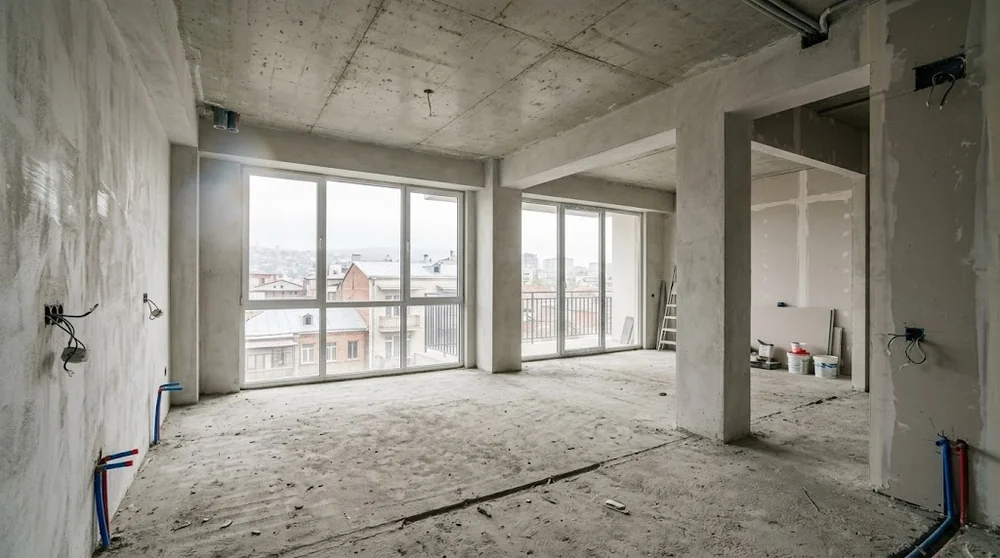
The purchase price is the largest outlay, but it is rarely the whole of the cash needed to complete and occupy an apartment. The cost of buying property in Georgia combines fixed official tariffs, negotiated quotations and, until you hold a written quote, planning assumptions.
The fixed figure verified for this article is registration. As of October 2026, the National Agency of Public Registry (NAPR) charges 150 GEL to register an ownership right within four working days, 270 GEL for one working day and 350 GEL for registration on the day of application. These NAPR amounts are fixed service charges, not a percentage of the purchase price.
| Cost item | Type of figure | What sets it | What to confirm |
|---|---|---|---|
| Property price | Contract term | Negotiation with the seller or developer | Currency, payment schedule, VAT wording |
| NAPR ownership registration | Official fixed tariff (as of October 2026) | 150, 270 or 350 GEL by service speed | Number of registrations the transaction needs |
| Legal review | Provider quotation | Lawyer’s scope and fee | Title, encumbrances, permits, contract clauses |
| Technical inspection | Provider quotation | Inspector’s scope | Damp, wiring, heating, building defects |
| Translation | Provider quotation | Number of pages and certification | Whether a certified translation is required |
| Notarial work | Situational | Certain documents, such as a power of attorney | Whether your transaction structure requires it |
| Brokerage | Negotiated | Written agreement with the agent | Who pays, how much and when |
| Bank transfers | Bank tariff | Sending, intermediary and receiving banks | All fees deducted along the route |
| Currency conversion | Bank rate and spread | Exchange rate on the day | Rate applied versus the official rate |
| Mortgage fees | Bank terms | Appraisal, arrangement fee, insurance | Written fee schedule and effective rate |
| Finishing and furnishing | Assumption until quoted | Delivery condition and specification | Contractor quote, timeline, rent during works |
Black frame, white frame and turnkey
New-build apartments in Georgia are commonly sold in one of three delivery states. A black frame apartment is essentially a shell with walls, windows and core connections. A white frame unit usually adds plastered walls, screed and basic wiring and plumbing points, although definitions differ between developers. A turnkey apartment is finished and ready to occupy, sometimes furnished.
These labels are contractual rather than standardised, so the specification annex matters more than the name. Check this before you sign — here’s why: a contract that says only ‘white frame’ may exclude the front door, radiators, boiler or electrical panel, and each of those then becomes your cost.
If you buy anything short of turnkey, budget for the works and for the rent you will keep paying while they take place. Hypothetical example: if finishing takes four months and your current rent is USD 600, that adds USD 2,400 of housing cost before you move in, on top of the contractor’s invoice.
VAT wording
Developer prices are usually quoted as final contract prices. Ask the seller to confirm in writing whether VAT is included, and check how the contract describes it. If the price is VAT-inclusive, adding VAT again in your budget counts it twice. If the seller is not VAT-registered, the question may not arise at all. A Georgian tax adviser can confirm the treatment for a specific contract.
Renting Costs Beyond the Monthly Rent
Renting requires far less cash than buying, but the cash needed on the first day is usually more than one month’s rent. The useful step is sorting that cash into refundable money, prepaid housing and genuine expense.
- First month’s rent: an expense for housing you will use.
- Security deposit: cash tied up and normally returned at the end of the lease, less documented deductions. It becomes an expense only if it is lost.
- Prepaid last month: rent paid in advance. It is not a second deposit and should be credited against the final month rather than held as security.
- Agent commission: where agreed, a genuine cost. Confirm in writing who pays and how much.
- Utilities and internet: electricity, gas, water, waste and internet are normally paid by the occupant, so they appear on both sides of a like-for-like comparison.
- Moving and set-up: transport, household items and, for an unfurnished flat, furniture and appliances.
- Repairs: the lease should state which repairs fall to the landlord and which to the tenant.
Hypothetical example: on a USD 600 monthly lease with one month’s deposit and the last month prepaid, move-in cash is USD 1,800. Only USD 600 is spent on the first month; USD 600 is prepaid future rent; the remaining USD 600 is refundable.
Clauses that protect the budget
Here’s the clause I always look for: a rent-review clause stating exactly when and how the rent can change. Without one, the cheapest-looking lease can become the most expensive. The wider checklist:
- Currency: the currency of the rent and of payment, particularly where rent is set in USD but paid in Georgian lari (GEL).
- Conversion method: the exchange rate used, for example the National Bank of Georgia official rate on the payment date.
- Rent changes: the dates, cap or formula for any increase.
- Summer terms: confirmation that the agreed rent applies through the summer and that the lease cannot be ended for the season.
- Notice: the notice period for each party and any early-termination charge.
- Repairs: responsibility for appliances, boilers and plumbing faults.
- Deposit return: the return deadline, permitted deductions and an inventory with dated photographs signed by both parties.
A written lease is a meaningful legal document in Georgia; the practical question is whether its terms are clear enough to rely on. Ask a Georgian lawyer to review anything unusual before you pay.
Annual Ownership Costs and Georgian Property Tax
Owner-only costs are the annual expenses a buyer pays that a tenant in the same home would not pay. Utilities do not belong in that line, because the tenant pays them too.
Shared and owner-only costs
Georgia property ownership costs typically include building service charges where the owner bears them (lift, cleaning, security, reception in managed towers), contributions to collective repairs, routine maintenance inside the apartment, insurance and any applicable property tax. Some leases pass service charges to the tenant; where that happens, those charges move to the shared side of the comparison.
Service charges vary sharply by building. A Soviet-era block in Saburtalo with an informal residents’ association may cost little in fixed charges but expose owners to irregular repair levies. A newer Batumi tower with security, a pool and reception may charge monthly under its management agreement. Ask the management company or residents’ association for the current tariff in writing and for the building’s recent repair history.
Maintenance and reserves
A replacement reserve is a planning allowance for items that wear out: boilers, appliances, flooring and paintwork. A reserve is a budgeting assumption, not a tariff, and it is not necessarily spent each year. In one year you may spend nothing; in another a boiler replacement absorbs several years of allowance. Spreading that lumpy spending evenly is reasonable for a comparison, provided everyone reading it knows the figure is an estimate.
Insurance is optional for many owners but sensible, particularly against water damage to neighbouring flats. Mortgage lenders normally require property insurance as a loan condition.
Georgian property tax
Georgia levies annual property tax, but whether an individual owner pays depends on statutory exemptions linked to household income and on the type of property held.
The exemption threshold could not be confirmed for publication at the October 2026 checking date. The English version of the Tax Code of Georgia retrieved during research shows a 40,000 GEL threshold; other material indexed in October 2026 reports 100,000 GEL; and the Revenue Service of Georgia has published an amendment notice. Until the effective Georgian-language amendment and the Revenue Service’s full guidance have been checked, this article does not state a current threshold or rate.
Three further points need verified, case-specific advice: how household income is defined, including whether foreign-source income counts; how residence status affects the position; and land, which is taxed separately and where municipal decisions influence the amounts. Do not assume that every foreign owner is exempt from property tax, and do not assume that one rate applies to everyone. A Georgian tax adviser can confirm the position for the relevant tax year.
A Three-, Five- and Ten-Year Cost Comparison
In the hypothetical scenario below, buying costs less than renting at every horizon before opportunity cost; once a capital charge and a 10% lower resale price are included, renting is cheaper at three and five years. That conclusion belongs to these inputs only and is not a market prediction.
Assumptions
All inputs are hypothetical, chosen to make the arithmetic reproducible. None is a Georgian market average, a quoted price or a forecast. The buyer pays cash for a furnished apartment at USD 100,000. Acquisition expenses are USD 3,000. Owner-only running costs are USD 1,500 a year. The equivalent furnished rent is USD 600 a month and stays flat. The resale price also stays flat at USD 100,000, and selling expenses are 3% of the sale price, or USD 3,000. Utilities are excluded because the occupant pays them under both options. The tenant’s security deposit is excluded from costs because it is returned, not permanently lost. Treat this as a simple Georgia rent vs buy calculator you can rebuild in a spreadsheet with your own numbers.
| Item (USD, hypothetical) | 3 years | 5 years | 10 years |
|---|---|---|---|
| Rent paid (600 × 12 × years) | 21,600 | 36,000 | 72,000 |
| Ownership cash outlays (price + acquisition + owner-only costs) | 107,500 | 110,500 | 118,000 |
| Net sale proceeds (100,000 less 3%) | 97,000 | 97,000 | 97,000 |
| Unrecoverable ownership cost before opportunity cost | 10,500 | 13,500 | 21,000 |
| Optional 4% simple annual opportunity charge on 103,000 | 12,360 | 20,600 | 41,200 |
| Ownership cost including opportunity charge | 22,860 | 34,100 | 62,200 |
| Stress case: resale 10% lower, including opportunity charge | 32,560 | 43,800 | 71,900 |
Reading the table
The purchase price is an outlay, but it is not wholly consumed expenditure. In the flat-price case, USD 97,000 of the USD 100,000 comes back at sale. The cost of ownership is the gap between everything paid out and what is recovered: USD 10,500 over three years, USD 13,500 over five and USD 21,000 over ten.
That figure ignores one real cost: the USD 103,000 committed to the purchase could have been held elsewhere. The table applies a 4% simple annual charge to that sum, which is USD 4,120 a year. The 4% opportunity charge is a simple approximation, not a compounded investment forecast or a promised alternative return. A buyer who would otherwise hold cash in a low-interest account faces a smaller charge; one with a more valuable use for the money faces a larger one. Under this approximation, ownership costs become USD 22,860, USD 34,100 and USD 62,200.
Compared with rent, the result is close at three years, where renting is USD 1,260 cheaper. Buying is USD 1,900 cheaper at five years and USD 9,800 cheaper at ten.
A lower resale price
Now assume the apartment sells for 10% less: USD 90,000 gross, or USD 87,300 after the assumed 3% selling expense. Net proceeds fall by USD 9,700, so every ownership cost rises by USD 9,700. Including the opportunity charge, ownership costs USD 32,560 over three years, USD 43,800 over five and USD 71,900 over ten. Renting is then cheaper at three and five years, and the ten-year result is essentially level with rent of USD 72,000.
No capital-gains tax arises from a loss in this illustration, but the selling charge, transfer costs and time on the market remain. Where a sale does produce a gain, a Revenue Service of Georgia brochure dated June 2026 illustrates 5% tax on the surplus from an apartment sold within two years; the conditions for that treatment should be checked with a tax adviser before applying it to a particular sale.
My assessment: the holding period and the exit price drive this comparison far more than small differences in fees. If the purchase only works when prices rise, it is relying on growth that nobody can promise.
Mortgages, Instalments and Currency Risk
Cash purchase versus mortgage
A mortgage repayment combines principal, which reduces debt, and interest, which is a consumed cost. Only interest, fees and insurance belong in the unrecoverable column; principal repaid becomes equity, subject to the eventual sale price.
No current mortgage rate is quoted here, because no written bank offer was verified for the October 2026 checking date. The method can still be shown. Hypothetical example: a buyer puts down USD 30,000 on the USD 100,000 apartment and borrows USD 70,000 over 15 years at an assumed 9% nominal annual rate with monthly payments. The payment is about USD 710 a month. Over the first five years the buyer pays about USD 42,600, of which about USD 13,950 reduces the loan and about USD 28,650 is interest. The outstanding balance after five years is about USD 56,050, and that balance must be repaid from the sale proceeds before the seller sees any cash.
The nominal rate understates the true cost of borrowing. The effective rate also reflects arrangement fees, appraisal, compulsory insurance and other charges. Ask each bank for its effective interest rate and complete fee schedule in writing, together with early-repayment terms and whether the rate is fixed or variable. A variable rate can reprice over the life of the loan, changing both the monthly payment and the total interest paid.
Eligibility for non-resident borrowers depends on the bank, income documentation and credit history, and on the National Bank of Georgia’s responsible-lending rules, which tie lending to income and loan-to-value limits. Those limits change over time, so confirm the current down payment and maximum term with the lender rather than relying on a figure from a forum or an older brochure.
If you are comparing a cash purchase with a mortgage or developer instalment plan for a specific apartment, a short one-to-one review of the contract terms and fee schedule can prevent expensive surprises.
Ask a question on WhatsApp
Once the loan terms are on paper, add the interest, fees and insurance to the ownership column of your model and keep repaid principal separate, because it is retained value rather than spending.
Developer instalments
Many off-plan sales in Tbilisi and Batumi are offered on developer instalment plans. These are contracts with the developer, not bank loans, and their terms vary widely. Check the payment dates, whether a balloon payment falls due at completion, the penalty for late payment, the delivery date and the remedy if the developer is late. During construction you pay instalments and rent at the same time; a model that omits rent before handover understates the cost of buying off-plan.
Currency mismatch
Property prices in Georgia are commonly quoted in US dollars, while many buyers earn in Georgian lari, euros or pounds. A USD loan or instalment plan repaid from income in another currency adds exchange-rate risk to every payment. The same risk applies at sale: proceeds converted back into your home currency may be worth more or less than the original outlay. Where possible, match the currency of debt to the currency of income, and stress-test payments for a weaker income currency.
Batumi, Gonio and Kvariati: Coastal Budget Risks
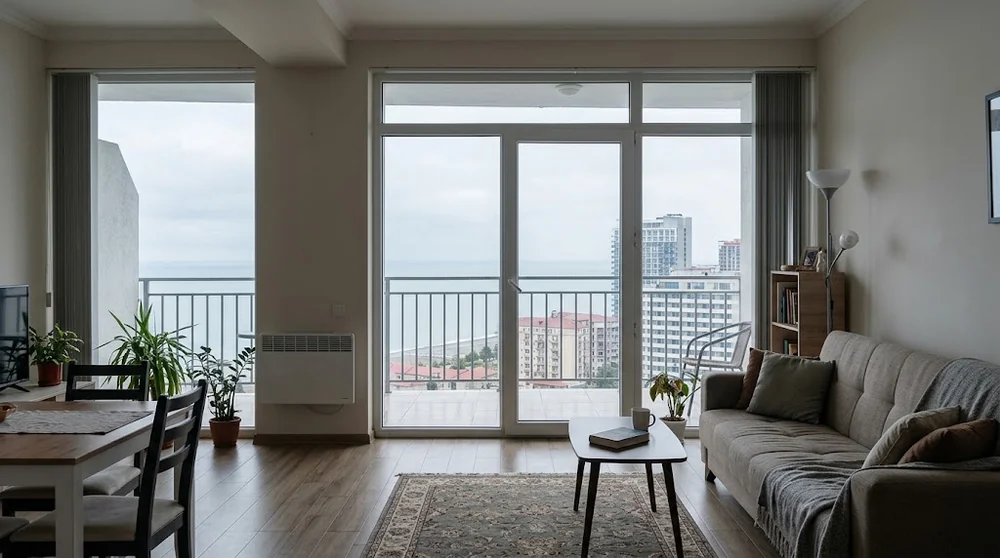
On the Adjara coast, a tenant’s main budget risk is often not the winter rent but whether the same home stays available at the same price in July and August. A full-year residential lease and a seasonal offer are different products, even in the same building.
- Full-year versus seasonal offers: a winter-only or holiday listing may look cheap from October to May, then end or reprice before summer. Ask for a twelve-month rent schedule in writing.
- Summer clauses: look for any right to raise the rent or terminate for the high season, and the notice period attached to it.
- Damp and ventilation: humid sea air in poorly ventilated flats can cause mould in winter. Inspect corners, wardrobes and window frames before signing or buying.
- Heating: in my observation, many coastal apartments rely on electric heaters or air-conditioning units rather than central systems, which shapes winter bills for tenants and owners alike.
- Coastal wear: salt air shortens the life of metal fittings, balcony railings and outdoor air-conditioning units, which raises an owner’s reserve.
- Service charges: managed Batumi towers often charge monthly fees; obtain the written terms and confirm whether a lease passes them to the tenant.
- Transport: a cheaper flat in Gonio or Kvariati can add commuting time and cost if you work or study in central Batumi.
Gonio and Kvariati need their own evidence. Their housing stock, seasonal mix and services differ from central Batumi, and no comparable dated average for either settlement was available at the October 2026 checking date. A citywide Batumi figure, from TBC Capital or any other source, should not be applied to them automatically.
Living in the Home Versus Letting It
An apartment occupied by its owner cannot earn full rental income for the same period. A rent-versus-buy comparison that credits the buyer with both avoided rent and full rental income counts the same months twice and overstates the case for buying.
Three cases should be modelled separately. Under owner occupation, the benefit of buying is the rent you no longer pay, which is how the model above works. Under investment letting, you keep renting your own home while a tenant pays rent on the apartment; the relevant measure is net rental income after vacancy, management, service charges, maintenance and applicable tax, set against the capital tied up. Under mixed use, such as living in Batumi for part of the year and letting the flat in summer, income covers only the nights the property is let, not the nights you occupy it.
For mixed use, start from gross rent for a realistic letting period, then deduct personal-use nights, empty nights, cleaning, management or platform fees, extra wear and any tax on rental income. Gross rent is not net income. The tax treatment of rental income depends on registration status and personal circumstances, so confirm it with a Georgian tax adviser before relying on any figure. Yield analysis is useful, but it answers a different question from whether to buy the home you intend to live in.
Before You Commit: A Budget Checklist
Before signing either a lease or a purchase agreement, work through these steps in order and keep the evidence for each one.
- Estimate your likely stay honestly, with a short case and a long case.
- Match an actual property for sale with an actual rental alternative of the same district, size, condition and furnishing.
- Obtain invoices and written quotations for registration, legal review, inspection, finishing and financing instead of relying on percentages.
- Inspect the title through the NAPR register and the physical condition through an independent specialist.
- Review the lease or purchase clauses: price, VAT wording, delivery date, payment schedule, rent changes, notice and deposit return.
- Stress-test the model with a flat price, a 10% lower price and, if borrowing, a higher interest rate.
- Retain enough liquidity for repairs, vacancy or a slow sale after completion.
- Consult independent Georgian legal, tax and mortgage specialists before committing.
Ownership and residence permission are separate questions. Buying an apartment does not by itself settle your right to stay in Georgia, so residence rules should be checked with the relevant authorities or an immigration lawyer.
If it helps, I can prepare an itemised comparison for a matched pair of properties. Share the city, your budget, your funding currency and how long you expect to stay, and the figures can be set out in the same format as the holding-period table above.
Buying vs Renting Property in Georgia: FAQ
Is it cheaper to buy or rent property in Georgia?
Neither option is universally cheaper. Compare the same home over your likely stay, including purchase expenses, owner-only running costs, financing, opportunity cost and net resale proceeds. Renting may suit an uncertain move; buying may suit a longer commitment. A calculation that assumes strong price growth can make buying look cheaper without establishing that it will be.
What costs should I budget for besides the purchase price?
Budget for registration, independent legal and technical checks, any translation or notarial work, agreed brokerage charges, bank transfers and currency conversion. An unfinished apartment also needs a separate finishing and furnishing budget. Ask which charges are included in the quoted price and obtain written estimates; a single percentage allowance cannot reliably cover every purchase.
How much does it cost to maintain an apartment in Tbilisi?
Maintenance costs for a Tbilisi apartment depend on the building, the apartment’s condition and the service package. Separate service charges, repairs, insurance and applicable property tax from utilities you would also pay as a tenant. Request recent bills and the building’s repair history. A replacement reserve is useful for budgeting, but it is an assumption rather than a fixed annual tariff.
Is there annual property tax in Georgia?
As of October 2026, Georgia has annual property tax, but an individual’s liability depends on statutory exemptions, household income and the relevant property and land rules. Do not assume that every foreign owner pays nothing or that one rate applies to everyone. Check the effective legislation and Revenue Service of Georgia guidance for the relevant tax year, with advice on your circumstances.
How does summer affect renting in Batumi?
Coastal rental terms in Batumi can differ between full-year housing and seasonal accommodation. A cheap winter listing does not establish the cost or availability of the same home in summer. Before paying, confirm the complete lease period, summer price, rent-review mechanism and termination rights in writing. Assess Gonio and Kvariati separately rather than applying a citywide Batumi figure.
How long should I stay in Georgia before buying makes financial sense?
There is no reliable universal minimum stay before buying in Georgia makes sense. The answer changes with acquisition and selling expenses, annual owner-only costs, borrowing terms, rent and the eventual sale price. Compare several holding periods and include a flat-price case and a downside case. Buying also requires enough liquidity to handle repairs and a sale that takes longer than expected.
Choose With a Complete Cost Comparison
There is no universal year after which buying in Georgia becomes cheaper than renting. The answer depends on how long you will stay, how much liquidity you can afford to lock up, how the purchase is financed and the property-specific costs of the matched home. In the hypothetical model, buying looked cheaper over longer horizons at a flat price, and that advantage shrank or disappeared once a capital charge and a lower resale price were added.
My view, shaped by a corporate-finance background, is to treat the decision like any other capital commitment: build the model on matched properties, written quotations and a cautious exit price, and buy only if the numbers still work without growth.
If you want to see which properties in Tbilisi, Batumi or along the coast fit your budget, preferred location and goals before running a matched rent-versus-buy comparison, a short questionnaire is a practical starting point.
Get a property shortlist for Georgia
Disclaimer: this article is general information based on sources checked in October 2026, and hypothetical figures are illustrations, not market data or forecasts. It is not financial, legal or tax advice; consult qualified independent specialists in Georgia before making any decision.
4 минуты назад