

Many Georgian new-build developments offer a payment schedule agreed with the developer instead of a single transfer. That usually means a deposit at signing, followed by monthly installments, construction-stage payments or a balance at handover. No single statutory model exists, so the schedule is whatever the contract says. I read it first, because it fixes your cash flow, your currency exposure and what happens if either side misses a date.
Property payment schedules in Georgia let buyers pay for property through a deposit followed by monthly installments, construction-stage payments or a final balance at completion. Developers set their own terms, and some offer interest-free plans. Foreign buyers should compare total prices, payment currencies, registration arrangements, late-payment penalties and developer risks before signing.

How Property Payment Schedules Work in Georgia
A property payment schedule in Georgia is the agreed timetable that sets how much the buyer pays a developer, on which dates or milestones, to which account and in which currency. It is a negotiated commercial term, not a mandatory national model. One developer may ask for 30% at signing and equal monthly payments, while another links payments to construction stages. In practice the schedule lives in an annex to the sale and purchase agreement, and that annex is the first document I ask to see.
The schedule combines three separate issues: financing (the developer lets you pay later), construction exposure (you may be paying for an apartment that is not yet built) and legal timing (payment and ownership registration are different events). A good annex answers all three in writing: the amount of each payment, the date or trigger, the receiving account, the currency, and the consequence of a missed date on either side.
Installments, mortgages and outright purchase
In an outright purchase, the buyer pays the whole price at or near signing, sometimes at a discount. In a bank mortgage, a licensed lender pays the seller and the buyer repays the bank under a loan agreement secured on the property. In a developer installment plan, the developer itself accepts deferred payment, so the developer, not a bank, is your counterparty for the whole period. Unlike a mortgage, no lender’s valuation or legal review necessarily stands between you and the developer’s promises.
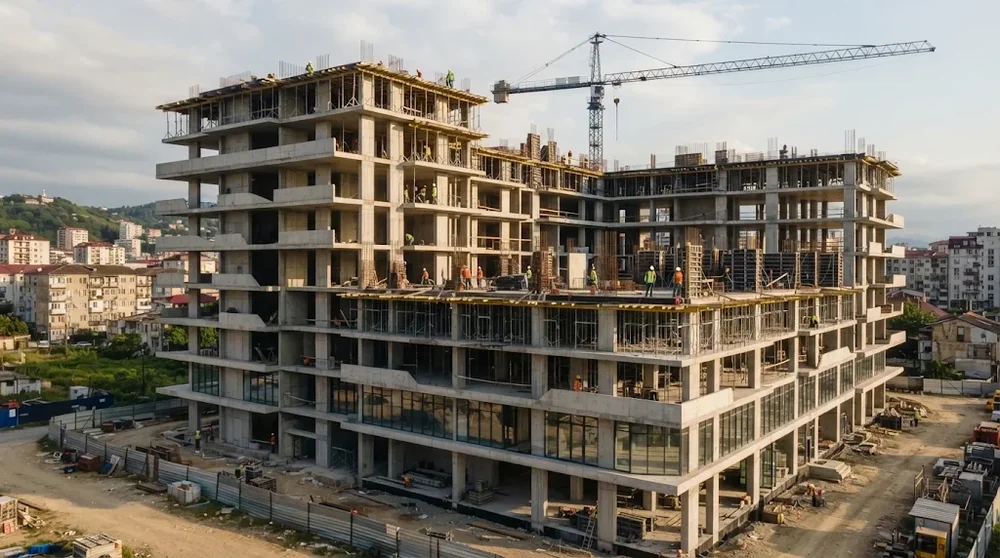
These plans are often offered on off-plan property, meaning an apartment sold before the building is complete. That is also where construction risk is concentrated.
The four-step process
- Reserve and agree terms. The buyer selects a unit and, if the developer charges one, pays a reservation fee that holds the unit while the contract is prepared. Confirm in writing whether the fee is refundable and whether it is credited against the price.
- Sign the sale and purchase agreement and pay the down payment. The sale and purchase agreement is the written contract that identifies the unit, the price and the payment schedule. The down payment is the first part of the price, paid at or shortly after signing.
- Pay the scheduled installments. Payments follow the payment annex: calendar dates, construction milestones or a mixture.
- Take handover and register ownership. Handover is physical delivery of the apartment. Ownership of immovable property depends on registration, so the two events can fall on different dates.
The main risks are construction delay, developer insolvency, unclear title, currency movements, penalties for late payment and difficulty recovering money if a project stalls. Each one is dealt with in the sections below.
Types of Georgian Property Payment Plans
Georgian payment plans fall into five structures: full payment, fixed monthly installments, construction-linked milestone payments, a deferred final balance and hybrids. The table compares them on a single framework. Individual developers combine and rename these structures freely, so the contract, not the brochure label, defines which one you are buying.
| Plan type | Cash-flow pattern | Possible advantage | Main risk | Suits |
|---|---|---|---|---|
| Full payment | Whole price at or near signing | Possible discount; simple contract | Most capital exposed before completion | Buyers with spare cash and a verified project |
| Fixed monthly installments | Down payment, then equal monthly amounts | Predictable budget | Payments continue whatever the build progress | Buyers with steady income who can verify progress |
| Construction milestones | Payments at stages such as foundation or frame | Payments follow physical progress | Disputes over what counts as complete | Buyers able to commission independent inspection |
| Deferred final balance | Small payments, large lump sum at handover | Low outgoings during the build | Lump sum due on a date you do not control; refinancing is not guaranteed | Buyers with a defined source for the final sum |
| Hybrid | Deposit, monthly payments and milestone steps | Can balance developer and buyer needs | Interacting clauses are easy to misread | Buyers who have negotiated and reviewed the annex |
Calendar dates versus certified milestones
A calendar-based schedule asks for payment on fixed dates whether or not construction has advanced. A milestone-based schedule asks for payment when a stage is completed. A genuine milestone needs an objective trigger, such as a signed engineer’s certificate or a documented inspection. A clause saying only that payment is due when the developer notifies completion of a stage is closer to an arbitrary date than a safeguard.
Deferred balances and completed property
A deferred final balance, sometimes called a balloon payment, leaves the largest amount until handover. If the buyer plans to refinance it, approval by a bank is never certain and depends on that bank’s current policy. For completed property, a short schedule or full payment is more common, and construction risk largely falls away. Title, mortgage and restriction checks still apply in full.
Down Payments, Interest and Installment Terms
No single deposit rule applies across Georgian developers. The deposit, the number of installments and the price are all set project by project, and often buyer by buyer. A deposit is simply the price multiplied by the agreed percentage: 20% of USD 100,000 is USD 20,000.
A reservation fee is a separate, usually smaller sum paid before the contract. Ask three questions in writing: is it refundable, is it deducted from the deposit, and by what date must the agreement be signed? From the deals I’ve handled, the answer to the second question is the one most often left vague.
Why the published ranges differ
Commercial platforms and agencies publish deposit and term ranges, and they do not agree. A September 2026 guide from Garant Group refers to starting deposits of roughly 10–20% and installment terms of up to 36–48 months in selected offers. Korter describes an approximate 0–40% deposit range. ZEM lists specific offers from October and November 2026 with deposits of 0% or 20% and terms of 36–48 months.
I treat all of these as unverified commercial observations. I have not confirmed them against signed developer terms, and no official dataset backs them. They come from different selections of projects, building stages and buyer categories, and promotional offers change quickly. They are not industry averages or promises of availability, and a 0% deposit is typically a promotion tied to one project, not a norm. What carries weight is a written quotation from the developer for the specific unit, with a date on it.
My assessment: the deposit percentage is the least informative number in an offer. The total price, the date of each payment and the penalty for missing one tell you far more.
Zero interest versus lower total cost
The short answer: a 0% plan is not necessarily cost-free. The longer answer: nominal zero interest means the contract states no separate interest charge. It does not say whether the installment price is higher than the price for paying immediately. If the developer quotes USD 100,000 on installments and USD 95,000 for cash, the financing cost sits in the price. Some plans may carry no premium at all against an equivalent immediate-payment quotation, which is why you ask for both figures in writing. Korter describes full-payment discounts of roughly 3–10% as a platform-specific observation, not a rule. The next section tests this on identical assumptions.
Example: A $100,000 Apartment Payment Schedule
On the assumptions below, a USD 100,000 apartment with 20% down and 24 equal installments costs USD 3,333.33 a month, with the last payment adjusted to USD 3,333.41. This is a hypothetical example, not an available product, market quotation or financing offer.
Assumptions
- Price: USD 100,000, fixed in USD, with no fees or interest stated.
- Signing date: 1 December 2026, with the deposit paid on that day.
- Initial payment: 20%, or USD 20,000, at signing.
- Remainder: USD 80,000 in 24 monthly installments, the first due on 1 January 2027, then on the 1st of each month, the final one adjusted for rounding.
- No currency movement, late payment or price change.
Complete installment schedule
| Period | Due date | Opening balance (USD) | Payment (USD) | Cumulative paid (USD) | Closing balance (USD) |
|---|---|---|---|---|---|
| Deposit at signing | 1 Dec 2026 | 100,000.00 | 20,000.00 | 20,000.00 | 80,000.00 |
| Month 1 | 1 Jan 2027 | 80,000.00 | 3,333.33 | 23,333.33 | 76,666.67 |
| Month 2 | 1 Feb 2027 | 76,666.67 | 3,333.33 | 26,666.66 | 73,333.34 |
| Month 3 | 1 Mar 2027 | 73,333.34 | 3,333.33 | 29,999.99 | 70,000.01 |
| Month 4 | 1 Apr 2027 | 70,000.01 | 3,333.33 | 33,333.32 | 66,666.68 |
| Month 5 | 1 May 2027 | 66,666.68 | 3,333.33 | 36,666.65 | 63,333.35 |
| Month 6 | 1 Jun 2027 | 63,333.35 | 3,333.33 | 39,999.98 | 60,000.02 |
| Month 7 | 1 Jul 2027 | 60,000.02 | 3,333.33 | 43,333.31 | 56,666.69 |
| Month 8 | 1 Aug 2027 | 56,666.69 | 3,333.33 | 46,666.64 | 53,333.36 |
| Month 9 | 1 Sep 2027 | 53,333.36 | 3,333.33 | 49,999.97 | 50,000.03 |
| Month 10 | 1 Oct 2027 | 50,000.03 | 3,333.33 | 53,333.30 | 46,666.70 |
| Month 11 | 1 Nov 2027 | 46,666.70 | 3,333.33 | 56,666.63 | 43,333.37 |
| Month 12 | 1 Dec 2027 | 43,333.37 | 3,333.33 | 59,999.96 | 40,000.04 |
| Month 13 | 1 Jan 2028 | 40,000.04 | 3,333.33 | 63,333.29 | 36,666.71 |
| Month 14 | 1 Feb 2028 | 36,666.71 | 3,333.33 | 66,666.62 | 33,333.38 |
| Month 15 | 1 Mar 2028 | 33,333.38 | 3,333.33 | 69,999.95 | 30,000.05 |
| Month 16 | 1 Apr 2028 | 30,000.05 | 3,333.33 | 73,333.28 | 26,666.72 |
| Month 17 | 1 May 2028 | 26,666.72 | 3,333.33 | 76,666.61 | 23,333.39 |
| Month 18 | 1 Jun 2028 | 23,333.39 | 3,333.33 | 79,999.94 | 20,000.06 |
| Month 19 | 1 Jul 2028 | 20,000.06 | 3,333.33 | 83,333.27 | 16,666.73 |
| Month 20 | 1 Aug 2028 | 16,666.73 | 3,333.33 | 86,666.60 | 13,333.40 |
| Month 21 | 1 Sep 2028 | 13,333.40 | 3,333.33 | 89,999.93 | 10,000.07 |
| Month 22 | 1 Oct 2028 | 10,000.07 | 3,333.33 | 93,333.26 | 6,666.74 |
| Month 23 | 1 Nov 2028 | 6,666.74 | 3,333.33 | 96,666.59 | 3,333.41 |
| Month 24 | 1 Dec 2028 | 3,333.41 | 3,333.41 | 100,000.00 | 0.00 |
Comparison with a 5% full-payment discount
| Option | Paid at signing (USD) | Paid later (USD) | Total (USD) |
|---|---|---|---|
| Installments, no discount | 20,000 | 80,000 over 24 months | 100,000 |
| Full payment, 5% hypothetical discount | 95,000 | 0 | 95,000 |
| Difference | 75,000 more up front | 80,000 less later | 5,000 saved |
In effect, the cash buyer pays USD 75,000 earlier to avoid USD 80,000 spread over 24 months. Method: I equate the USD 75,000 of extra upfront money to the present value of 24 monthly payments of USD 3,333.33, with the first payment falling one month after signing. The monthly internal rate of return that solves this is about 0.52%. Annualised, that is roughly 6.3% on a simple (nominal) basis, or about 6.4% compounded. Read it as a hypothetical implied financing rate for this particular payment stream, not as a market lending rate and not as a forecast of any investment return.
It is tempting to say that a buyer who can earn more than that on spare cash should take the installments. The comparison is not that simple. Any alternative return has to be measured after tax, after fees and adjusted for risk, and it has to be available on the same dates and with the same liquidity as the cash it replaces. A contractual obligation of USD 3,333.33 a month is certain, while an investment return is not. A higher nominal yield elsewhere does not automatically make installments the cheaper choice. Real offers need the same arithmetic on their own figures.
A separate milestone schedule
| Stage (hypothetical) | Share of price | Payment (USD) | Cumulative (USD) | Balance (USD) |
|---|---|---|---|---|
| Signing | 30% | 30,000 | 30,000 | 70,000 |
| Frame completed and certified | 20% | 20,000 | 50,000 | 50,000 |
| Building envelope completed and certified | 20% | 20,000 | 70,000 | 30,000 |
| Handover accepted in writing | 30% | 30,000 | 100,000 | 0 |
The dates of milestone payments depend on construction progress, so no calendar is shown. The schedule is illustrative only. None of these figures forecast exchange rates, prices or availability.

Property Payment Plans vs Bank Mortgages
A developer installment plan and a bank mortgage are different products with different providers, costs and protections. A developer’s willingness to accept installments says nothing about whether a bank would lend to the same buyer, because a bank applies its own underwriting.
| Feature | Developer installments | Bank mortgage | Outright payment |
|---|---|---|---|
| Provider | The developer | A licensed bank | Not applicable |
| Cost | Often embedded in price | Interest plus fees | Possible discount |
| Interest | May be nominally 0% | Stated in loan agreement | None |
| Term | Set per project | Set by bank policy | None |
| Credit approval | Developer’s discretion | Bank underwriting | None |
| Collateral | Contractual terms | Usually the property | None |
| Currency | Contract-specific | Bank-specific | Contract-specific |
| Early repayment | Subject to the contract and Georgian law | Per loan agreement | Not applicable |
| Documentation | Agreement and annex | Loan file, income evidence, property papers | Agreement |
Mortgage availability for foreign nationals depends on current underwriting, income, residency, property status and each bank’s own policy. Banks may be reluctant to lend against a unit in a building that is still under construction. I have not verified any specific bank product for this article, so check current terms directly with the lender.
Some buyers plan to pay a developer in installments and refinance the later balance with a bank. That is a possibility, not a promise, and a schedule that depends on future approval is a schedule with an unfunded gap. If the final balance is large, have a fallback source ready.
Ownership Registration and Payment Protection
Paying a developer does not make you the registered owner. Under Article 183 of the Civil Code of Georgia, acquiring ownership of immovable property requires a written transaction and registration of the acquirer’s title in the Public Registry, administered by the National Agency of Public Registry (NAPR). This position is stated in Georgian legal commentary as of November 2026. Your contract gives you contractual claims against the developer. Registration gives you ownership.
Six checks on title and payment protection
- Identify the property by cadastral code. A cadastral code is the unique identifier of a plot or unit in the registry. Ask for the code of the land plot and, once registered, of your unit, and make sure it matches the agreement.
- Obtain a current Public Registry extract. The extract shows the registered owner, the cadastral code, the area and registered rights or restrictions. It does not prove that the building will be finished, that permits are in order or that the developer will perform the contract.
- Look for mortgages and restrictions. A registered mortgage or restriction on the land may affect your position. Ask the developer to explain each entry in writing and how it will be released.
- Establish when registration can happen. Article 2 of the Law of Georgia on the Public Registry treats buildings and building units under construction as immovable things, so incomplete construction does not universally prevent registration. Four situations need to be kept apart: existing registered ownership (usually the developer’s title to the land), your contractual claim under the agreement, a registrable obligation or right recorded at a given stage, and the possible registration of an individual under-construction unit in your name. Whether your specific unit can be registered depends on how it is identified, what supporting documentation exists and how the transaction is structured. Do not assume that you become owner only after the final payment, or immediately on signing. Have a Georgian lawyer confirm the exact arrangement in your contract.
- Separate direct payment from escrow. Most developer installments are paid directly to the developer’s account. Escrow, where a third party holds funds until conditions are met, exists only if the contract or a service provides for it.
- Know the narrow scope of Smart Contract. NAPR’s Smart Contract service handles registration of ownership transfers through a video session and an escrow arrangement. As of November 2026, NAPR’s published instructions say the price can only be specified and paid in lari, through escrow at JSC Bank of Georgia, and that both parties need lari accounts there. Two further points matter. First, geographic access is not the same as eligibility. NAPR’s published Smart Contract FAQ (November 2026) identifies Georgian citizens holding a valid Georgian ID card or passport as eligible users, and that FAQ does not allow a representative to take part in the video transaction itself. A foreign national who does not meet those criteria must not assume access, and should confirm current eligibility directly with NAPR. Ordinary registration, or a properly authorised representative where the law permits, is the route to discuss with a Georgian lawyer. Second, standard escrow settlement releases the funds after ownership is registered. NAPR describes a separate instant-transfer option for certain combined purchase-and-mortgage transactions, under which funds can reach the seller after the registration application is accepted but before ownership is registered. Neither procedure should be treated as general protection for recurring off-plan developer installments.
The most common title misconception I see is treating a registry extract as a project guarantee. It confirms who is registered and what is encumbered on the day it is issued. It says nothing about construction.
Contractual claim versus registered ownership
A contractual claim is a right to demand performance from the developer. It can be hard to enforce if the developer becomes insolvent. Registered ownership is a right against the property itself, visible to third parties. The gap between the two is the period of greatest buyer exposure. The Law of Georgia on the Public Registry, published on the legislative portal, sets out the registration framework.

Contract Clauses to Check Before Paying
Before any transfer, check that the contract fixes the price, identifies the exact unit, attaches the payment annex and says what happens on delay by either side. Verify each clause against a document, not against a promise from a sales agent.
- Total price. Confirm the figure, its currency and what it includes (parking, storage, finishing, VAT where relevant). Check it against the signed annex, not the brochure.
- Property identification. The agreement should state unit number, floor, area, layout plan and cadastral code. Compare each against the approved plan and the registry.
- Payment schedule appendix. Insist that the full schedule is attached and signed. Check that the amounts add up to the price.
- Exact due dates. Look for fixed dates or an objective trigger. For milestones, check who certifies completion and how you receive the certificate.
- Beneficiary account. The account holder should match the contracting developer. Verify by calling a number from the contract, not from an email.
- Currency and conversion formula. If the price is in one currency and payment is in another, the clause should state the rate source, the rate date, the settlement deadline and the rounding method. The National Bank of Georgia publishes an official exchange rate, but states that it is indicative and generally not obligatory unless the law requires it. A contract can adopt it as a reference rate, though nothing makes that mandatory. If your bank does the conversion, the rate you actually receive is the bank’s own buy or sell rate, including its spread. See the NBG official exchange-rate page (November 2026).
- Late interest and grace period. Check the rate, the day from which it accrues and any grace period before it applies.
- Notice and cure. A notice and cure clause gives the defaulting party written notice and a set time to fix the breach. Look for its length and the method of service.
- Cancellation and refunds. Read what the buyer receives if they cancel, if the developer cancels and if the developer fails to deliver. Do not assume a deposit is refundable.
- Construction deadline. Distinguish a binding handover date from a projected completion date. A projected date in marketing material does not by itself create an enforceable obligation.
- Force majeure. Check which events extend the deadline and for how long.
- Material changes. Check whether the developer may change area, layout or specification, and what tolerance applies before you may object.
- Delivery condition and acceptance. State whether the unit is delivered as a bare shell or finished, and how handover is recorded.
- Defect correction. Look for a procedure and a deadline for fixing defects after handover.
- Registration obligations. Check who files, who pays registration fees and by when. A developer obliged to register your title within a stated period is a safeguard.
- Assignment. Whether you may transfer your position to a third party before completion is subject to the agreement and applicable Georgian law. Check for any consent requirement and assignment fee, and have both reviewed by a lawyer.
- Early repayment. If you want to pay the balance early, check what the contract says and what Georgian law allows, and whether early payment earns any discount. Restrictions on early payment should be reviewed before signing.
- Dispute resolution. Note the governing law, the court or arbitration forum and the contract language. Obtain a certified translation of any clause you cannot read.
Here’s the clause I always look for: the one that says what the developer owes you if it misses the handover date. If the contract has no express delay penalty, the buyer may lose a clear contractual remedy and may need to rely on other contractual or statutory rights. That is exactly the point to put to an independent Georgian lawyer before you sign.
Negotiated protections versus statutory rights
Many of these protections exist only if the contract grants them. The Civil Code provides a general legal framework, but a buyer should not assume that a refund, a penalty or an exit right exists unless the text says so or a Georgian lawyer confirms the statutory position.
Exit rights and delay risk
Ask what you can do if the project slips: terminate, claim penalties, reschedule or wait. Compare payment obligations with the developer’s delivery obligations, because a contract that binds you tightly and the developer loosely is a warning sign. Gather the building permit, the land registry extract, the draft agreement and the annex, and ask an independent Georgian lawyer to review them before signing.
Currency, Transfers and Costs for Foreign Buyers
The contract currency is the currency in which the price is denominated, and the settlement currency is the currency in which you actually pay. They can differ, and the difference is where foreign buyers lose money, because the conversion rate, spread and fees are set by banks and by the contract. The National Bank of Georgia’s official rate is a published reference, not the rate your bank will necessarily give you, so the contract should say which one applies.
Operational steps for an overseas payment
- Confirm the instruction in the contract. The beneficiary name, account number, bank and reference should come from the signed agreement.
- Verify the recipient. Call the developer on a number taken from the contract. Treat any emailed change of account details as suspect until verified.
- Prepare source-of-funds evidence. Banks on both sides may ask for documents showing where the money came from, such as salary records, a sale agreement or statements. Prepare them before sending.
- Send an international bank transfer with the correct reference. This is an international bank transfer using SWIFT messaging, where supported by the sending and receiving banks. Use the unit number and contract number as the reference.
- Count the costs. Compare your bank’s exchange-rate spread, sending fee, intermediary charges and the recipient bank’s fees. Ask whether charges are shared or paid by the sender.
- Keep evidence and reconcile. Retain the transfer confirmation and obtain a written receipt from the developer. Check the amount credited against the annex.
The mistake I see buyers make most often: paying to an account whose holder or currency was not confirmed in writing. A wrong beneficiary is expensive to correct and may not be recoverable.
If you cannot attend in person, the contract may be signed through a representative under a power of attorney, where the law and the transaction allow it. Authentication requirements depend on the issuing country and on applicable treaties. A foreign notarised power of attorney may need an apostille or consular legalisation, some countries may benefit from treaty-based exemptions, and a Georgian translation may also be required. Confirm the applicable procedure with NAPR or a Georgian lawyer before you have the document signed abroad. Remote access is a separate question from eligibility: as explained above, NAPR’s Smart Contract service is open to Georgian citizens with valid Georgian identity documents, and its FAQ does not allow a representative to take part in the video transaction itself (November 2026). A foreign buyer should not plan around that service without confirming eligibility with NAPR.
Illustrative currency stress test
Assume, purely for illustration, a GEL 270,000 contract at an assumed rate of 2.70 GEL per USD, with 80% (GEL 216,000) still to be paid. The rates below are assumptions, not forecasts.
| Assumed rate (GEL per USD) | Change in GEL value | Remaining GEL 216,000 in USD | Difference from USD 80,000 |
|---|---|---|---|
| 2.835 | GEL 5% weaker | 76,190.48 | −3,809.52 |
| 2.700 | No change | 80,000.00 | 0.00 |
| 2.565 | GEL 5% stronger | 84,210.53 | +4,210.53 |
| 2.430 | GEL 10% stronger | 88,888.89 | +8,888.89 |
If the buyer also loses 1.5% in spread and bank charges (an assumption), that adds about USD 1,200 on USD 80,000. Denomination and settlement have to be read together. A contract fixed in the currency you earn in removes the exchange-rate mismatch only if the actual settlement obligation is also fixed in that currency, with no adjustment clause. A USD-denominated price paid in GEL at a floating conversion rate can still expose a USD-earning buyer to spreads, timing differences and contract-specific adjustments.
On fees, NAPR’s published schedule, checked in November 2026, lists standard ownership-registration fees of 150 GEL within four working days, 270 GEL within one working day and 350 GEL on the day of filing. NAPR states that the Smart Contract service uses the same registration fees and charges 35 GEL for escrow. Fee schedules change, so verify them again before you rely on them for a transaction date.
Questions about a developer’s payment account, a currency clause or a transfer reference are easier to settle before the money moves. A short one-to-one check of your draft contract can catch mismatches that are costly to fix afterwards.
Registration fees are one example of why every figure in a property deal needs a date attached. The same applies to local offers, which change faster than fee schedules.
Payment Schedules in Tbilisi and Batumi
Payment schedules in Georgia are set project by project, not city by city, so compare individual developments rather than relying on a city average. I have not obtained verified developer quotations for this article, so the table below is a reusable blank worksheet, not a set of market data. Use it for Tbilisi, Batumi, Gonio and Kvariati, with one row per project, filled only from the developer’s signed or written terms and the date of each quotation.
| Locality | Project and unit type | Quoted price | Deposit | Term | Delivery target | Offer date and source |
|---|---|---|---|---|---|---|
| Tbilisi | Project A: ____ | ____ | ____ | ____ | ____ | ____ |
| Tbilisi | Project B: ____ | ____ | ____ | ____ | ____ | ____ |
| Batumi | Project C: ____ | ____ | ____ | ____ | ____ | ____ |
| Batumi | Project D: ____ | ____ | ____ | ____ | ____ | ____ |
| Gonio or Kvariati | Project E: ____ | ____ | ____ | ____ | ____ | ____ |
For each row, ask for the cash price and the installment price of the same unit, and compare the pair using the method from the worked example above. Two projects with the same deposit percentage can differ sharply in total cost and in delay protection.
Third-party observations, kept separate
The deposit and term ranges quoted earlier come from commercial sources: a Garant Group guide (September 2026), Korter’s general description and ZEM listings (October to November 2026). They mix several locations and project types, I have not verified them against developer documents, and they are not a regional norm. Treat them as promotional examples that tell you what is being advertised, not what you will be offered.
Tbilisi
Check the building permit with the issuing municipality, the land title and any registered mortgage on the plot. Compare phases of the same development, since a later phase can carry different terms and different completion risk.
Batumi
Batumi has many high-rise projects at different construction stages. Ask whether the unit is residential or part of a hotel-type arrangement, and what the contract says about the finished condition and any operator or management agreement.
Gonio and Kvariati
Gonio and Kvariati are coastal settlements south of Batumi. Treat them as locality-specific due-diligence cases: confirm the land category and permitted use, utilities and road access, and the phasing of the project. Do not assume that payment patterns seen in Batumi apply here.
Choosing between cities, budgets and payment structures is easier with a defined brief. If you want to shortlist projects by budget, location and investment goals before comparing schedules, a structured questionnaire turns those preferences into a selection.
A shortlist is only a starting point. Each project on it still needs the document checks and schedule comparison described in this article.

What Happens if Construction or Payments Are Delayed?
What happens in a delay depends first on the contract, then on Georgian law, and outcomes are never certain. The table separates six scenarios and what to check in each. It is a framework, not legal advice.
| Scenario | Contract provisions | Documents | Immediate steps | Professional advice |
|---|---|---|---|---|
| Buyer misses a payment | Late charges, grace period, notice, termination | Annex, payment proof, notices | Contact developer; document any rescheduling | Before signing any revised schedule |
| Developer misses handover date | Binding date, delay penalty, termination right | Agreement, correspondence | Send written notice; record dates | To assess penalty or termination options |
| Building incomplete at deadline | Extension, force majeure, partial delivery | Permit, progress evidence | Request a written revised timetable | To review amendment before signing |
| Construction suspended | Notice duties, suspension of payments | Dated photographs, site reports | Do not unilaterally suspend payments without reviewing the contract and obtaining legal advice on any statutory right to suspend or withhold performance | Early, before any amendment |
| Quality disagreement | Acceptance and defect procedure | Handover record, inspection report | List defects in writing within the contract period | With an independent inspector |
| Developer insolvency | Termination and refund terms | Payment receipts, registry extract | Gather all payment evidence | Immediately; recovery is uncertain |
Two payment structures under delay
The same construction delay hits a calendar schedule and a milestone schedule very differently. Both outcomes below are subject to the contract and to Georgian law.
| Question | Fixed monthly payment falls due while the build is behind | Milestone payment whose certified trigger has not occurred |
|---|---|---|
| Is the payment due? | Usually yes, because the due date is a calendar date unrelated to progress | Usually no, because the stage has not been certified |
| Payment timing | Keeps running on schedule unless the contract or law gives a right to withhold | Moves back with the build, so the buyer’s cash outflow slips too |
| Notices | Send written notice of the delay before or at the due date, and keep paying under reservation of rights if advised | Ask the developer in writing to confirm the stage status and who is to certify it |
| Amendments | Developer may propose a new timetable; sign only after legal review, because it may reset your leverage | Developer may propose to redefine the trigger; check the new wording is still objective |
| Remedies | Delay penalty, termination or damages if the contract or law provides them | Dispute usually centres on whether the stage was completed; an independent inspection report helps |
| Developer default | Payments already made are at risk; recovery depends on the clause and solvency | Less money paid, so less exposed, though not zero |
Notices, cure periods and amendments
Most disputes start with a missed deadline and a missing notice. Follow the contract’s notice method exactly (written, addressed, dated) and keep proof of delivery. A cure period is the time given to fix a breach before termination can follow. Any rescheduling should be a signed amendment, not a verbal assurance.
Termination and recovery
Termination may be available to either side if the contract or the law allows it. Whether a deposit or earlier payments come back depends on the clause, the cause of termination and the developer’s ability to pay. Recovery is never guaranteed, and a claim against an insolvent developer may be slow and partial.
Good documentary evidence can materially strengthen your position in a dispute. Dated photographs, signed certificates and written notices carry more weight than recollection.
Verifying milestones independently
For milestone plans, commission an independent engineer to inspect the stage before you pay, compare the building’s progress with the permit documentation, and keep the report with your payment records.
Assignment, early repayment and paying in full
Assigning an unfinished unit to another buyer is subject to the agreement and applicable Georgian law, and may carry a fee. Three things should be kept apart: transferring a contractual claim, transferring contractual obligations (which normally needs the other party’s involvement) and transferring registered property rights. The new buyer inherits the same risks. Early repayment likewise depends on the agreement and the Civil Code, and paying the entire balance before delivery removes your leverage if problems follow. Ask a lawyer to review any consent requirement, assignment fee, early-payment restriction or discount clause before you rely on it.
A Seven-Step Checklist Before Signing
Before signing, verify the developer and title, check permits and construction status, obtain the full written schedule, compare total costs, test currency and funds protection, negotiate delay and exit clauses and have an independent lawyer review the contract. Keep a file of each document.
- Verify the developer and title. File the company’s registration details and the dated registry extract for the land.
- Check permits and construction status. File the construction permit as confirmed with the municipality, plus dated site photographs.
- Demand the full written payment schedule. File the signed annex showing amounts, dates, account and currency.
- Compare complete acquisition costs. Add the price, financing premium, registration fees, transfer costs and any management or furnishing charges to one comparison sheet.
- Assess currency and funds protection. Run the stress test on your own numbers and file bank confirmations showing whether funds go to the developer or through escrow.
- Negotiate delay and exit clauses. Ask for a handover date, a delay remedy, a cure period and clear refund terms, and keep the correspondence.
- Obtain an independent contract and registration review. Use a Georgian lawyer who does not work for the developer, and keep the written advice.
If you would like a shortlist compared on identical assumptions, you can request a comparison of available Georgia property payment schedules and a documentation review. Every commercial arrangement must be checked individually, and no review can guarantee financing, completion or returns.
Frequently Asked Questions
Can a foreigner buy property in Georgia with an installment plan?
Yes, in most cases. Foreign nationals can generally buy eligible residential property in Georgia, including under developer installment agreements, without first obtaining residency. The developer decides whether a particular buyer qualifies and on what terms. Agricultural land is governed separately by the Organic Law of Georgia on Agricultural Land Ownership, which contains specific ownership categories and exceptions, so eligibility depends on the land classification, the legal ownership structure and any applicable statutory exception. It is not an unconditional bar in every transaction. Verify the registered category and the legal route before signing, especially where a development includes agricultural land. Developers and banks may also request source-of-funds documents.
How much is the usual down payment for a Georgian apartment?
No standard down payment applies to all Georgian developers. Commercial sources quote very different ranges: Garant Group (September 2026) cites starting deposits of about 10–20%, Korter describes roughly 0–40%, and ZEM listed offers with 0% or 20% in October and November 2026. I could not verify any of these against developer documents, so treat them as unverified promotional observations, not averages or current availability. Some developers apply different terms to non-residents. Ask for the written terms for the specific unit.
Are 0% property installment plans in Georgia really free?
Not necessarily. A 0% plan usually means the developer states no separate interest, but the installment price can be higher than the price for immediate payment. A cash discount, administrative charges or a higher list price may carry the financing cost instead. Ask what the price would be for immediate payment. Compare both written quotations on identical terms before deciding which option costs less overall.
What happens if I miss a payment to a Georgian property developer?
The outcome depends on the signed agreement and Georgian law. The contract may provide late-payment charges, a grace period, formal notice, suspension of the developer’s obligations or termination. Notice deadlines can be short. Never assume a deposit is refundable. Tell the developer promptly, document any agreed rescheduling in writing and take independent legal advice before accepting a cancellation or signing a revised schedule.
When does an apartment bought in installments become legally mine?
Under Article 183 of the Civil Code of Georgia, acquiring ownership of immovable property requires a written transaction and registration of the ownership right in the Public Registry. A deposit or an advertised completion date does not by itself establish ownership. Timing depends on the transaction structure and on whether the individual unit can be registered at that stage, so obtain a current registry extract and legal review.
Should I pay for an apartment in full or choose installments?
Full payment may secure a lower price but commits more capital immediately. Installments preserve liquidity and spread payments over time, although the total price and contractual exposure may be higher. Compare written offers for the same apartment using identical delivery assumptions, currency and fees. Liquidity needs and currency exposure usually decide the question. Neither option removes developer or title risk.
Key Takeaways for Buyers
A payment schedule in Georgia is a negotiated contract term, not a legal standard, so the useful comparison is between written offers, not between cities or headline percentages. A 0% plan can still cost more than paying in full, as the USD 100,000 example shows, and the implied financing rate of about 6% there is a property of that hypothetical, not a market rate.
Ownership and payment are separate. As of November 2026, ownership of immovable property depends on a written transaction and registration, direct payments to a developer are not escrow, and NAPR’s Smart Contract service is limited in scope and eligibility. Foreign buyers should confirm eligibility with NAPR before planning around it.
I came to Tbilisi about eight years ago from corporate finance in London, and my method has not changed: test the numbers, read the clauses, date every figure and verify the paper before the money moves. Do that, and the schedule becomes something you control rather than something you merely accept.
Disclaimer: This article is general information as of November 2026 and not legal, tax or financial advice. It contains hypothetical examples and dated third-party observations that may not reflect current offers. Laws, fees and developer terms change. Take independent Georgian legal advice and suitable financial advice before signing any agreement or transferring funds.