
The safest developer to buy from in Georgia is not necessarily the one with the biggest portfolio. A familiar name shows marketing reach. It does not show that the building you are about to pay into is legally clean, and in Georgia the brand on the hoarding, the company on the contract and the owner of the land can be three different parties. This comparison sets out which names are useful starting points in Tbilisi and Batumi, what can and cannot be established about each, and which documents you should hold before a deposit leaves your account. It reflects research as of November 2026. One limit up front: the article is a due-diligence framework plus an evidence-status table, not a league table. Where I could not verify a claim, the table says so.
The best-known property developers in Georgia include Archi, m², Axis and Domus in Tbilisi, and Alliance Group, ORBI Group, NEXT and Gumbati in Batumi. None is automatically the safest choice. Compare completed buildings, construction permits, land ownership, mortgages, delivery records and contract protections before selecting a developer or paying a deposit.

What Makes a Property Developer Reliable in Georgia?
The short answer: a reliable developer is one whose completed buildings, project paperwork and contract terms can each be verified independently. The longer answer: these are separate tests, and a company can pass one while failing another. Brand reputation, legal reliability, delivery experience, building quality and contract safety are five different things. All five can be assessed, but only project-specific legal, delivery, quality and contractual evidence can establish the safeguards relevant to a particular purchase.
Reputation is how widely a name is recognised. Legal reliability concerns one specific project: who owns the land, what is registered against it and what the permit allows. Delivery experience is a company’s record of finishing and handing over buildings. Building quality is what residents live with after handover. Contract safety is what the buyer can enforce if something goes wrong.
Delivery Record
A delivery record counts only if the buildings were completed, accepted into operation and handed to buyers. Advertised completion, physical handover and official acceptance are different events. Developers often cite project totals, and the definitions vary: units, buildings, phases or whole schemes may be counted, and announced projects sometimes sit in the same figure as finished ones. Ask for a list of buildings with addresses and cadastral codes, then check a sample yourself. The matrix below shows what to request at each stage.
| Stage | Document to request | Issuing party | How to verify |
|---|---|---|---|
| Physical construction completion | Technical completion statement or supervising engineer’s report | Developer, contractor or supervising engineer | Site visit with an independent engineer; compare with the approved design |
| Acceptance into operation | Document recording that the building was accepted into operation (commissioning) | Competent construction authority for the location | Ask the authority to confirm the document; compare address and cadastral code |
| Handover to the buyer | Signed handover (acceptance) act and snag list for the unit | Developer and buyer | Inspect the unit against the specification schedule before signing |
| Individual-unit registration | Public Registry extract showing the unit and the registered owner | NAPR | Order a fresh extract for the unit’s cadastral code |
Legal and Financial Transparency
Legal transparency means the developer can name the exact Georgian legal entity, show the land record and produce the construction permit without delay. Financial transparency means you can see how your instalments are protected, whether the land is mortgaged and how the project is funded. A refusal to produce records is itself information, but a missing document in a file you have been given is not proof that the document does not exist. It is a reason to ask.
Quality After Handover
Quality is visible only after residents have lived through a few winters and a rainy season. Look at façades, waterproofing, lifts, drainage and how the management company behaves when something fails. Aftercare is a contractual question too: ask who repairs defects, for how long and at whose cost.
A Proposed Editorial Scoring Model
The model below is my own editorial method. It is not an official standard, a regulator’s rating or an industry benchmark, and the weights reflect judgement about where buyer losses tend to arise. Each criterion is scored 0 to 5 and only on documents actually seen.
- Completed-project evidence: 25%. Buildings accepted into operation, traceable by address or cadastral code.
- Project legality: 25%. Land ownership, encumbrances, permit scope and registrable unit rights for the specific project.
- Financing and payment safeguards: 20%. How instalments are protected, funding sources and mortgage release arrangements.
- Construction quality and aftercare: 15%. Physical condition of older buildings and defect-handling terms.
- Contractual fairness: 15%. Delay remedies, refund terms, cancellation rights and dispute resolution.
| Score | Meaning | Minimum documentary evidence |
|---|---|---|
| 0 | Verified adverse condition | A verified adverse condition or a documented failure to meet a mandatory safeguard, for example a permit that does not match the advertised building. Absence of evidence is never scored 0 |
| 1 | Serious gaps | Some documents seen, but key items (owner link, permit scope) unexplained |
| 2 | Partial | Core documents seen; material open questions remain |
| 3 | Adequate | Core documents seen and consistent with each other and the contract |
| 4 | Strong | As 3, plus independent confirmation from an authority or an engineer |
| 5 | Exceptional | As 4, plus enforceable protective terms visible in the signed contract |
The weighted total is the sum of each score multiplied by its weight, divided by 5 and expressed out of 100. Evidence confidence is graded separately from performance, and it distinguishes between a document being supplied, being authentic and being independently validated:
- A: primary documents that have been independently authenticated, for example a registry extract you ordered yourself or a permit confirmed by the issuing authority.
- B: credible evidence that is independently corroborated but only partly verified, for example consistent independent accounts, or developer-supplied copies that match some public records.
- C: uncorroborated company representations, including documents supplied by the developer that have not been checked against an authority.
- N/E: no evidence, recorded separately and never treated as a low grade.
Project-level confidence is the lowest grade among the criteria weighted 20% or more; the grade for each criterion is shown alongside it. Missing data is never scored as zero and never filled in with an assumption. If any criterion weighted 20% or more has no evidence, the developer is classed ‘Insufficient evidence — not rated’, and if the remaining criteria are used for internal comparison the total is not published. A grade of C reflects a gap in the evidence and should never be read as misconduct. This article awards no numerical scores, because the underlying documents have not been collected and checked.
Tbilisi vs Batumi Developers: Comparison Table
No developer in the table can be called safe or unsafe on the basis of its name. The table records evidence status as of November 2026, with every field separated into what the company says and what has been independently confirmed. The label ‘Not independently verified’ means that this review did not audit registry files for the company or its projects. It does not mean that the documents are absent.
| Developer | Location | Typical property type (company-described) | Company-reported completions | Confirmed acceptance into operation | Legal entity and ID | Evidence confidence | Unresolved checks |
|---|---|---|---|---|---|---|---|
| Archi | Tbilisi | Residential apartment schemes | Reported by the company; not audited here | Not independently verified | Not verified; request from seller | C (company statements only) | Contracting entity, landowner, permit scope, which phases are accepted into operation |
| m² | Tbilisi | Residential apartments; serviced or hotel-style formats have appeared in its materials (confirm per project) | Reported by the company; not audited here | Not independently verified | Not verified; request from seller | C | Private apartment or part of an operated scheme; management terms |
| Axis | Tbilisi (the name may be used in other contexts, so confirm city and entity) | Apartment projects | Reported by the company; not audited here | Not independently verified | Not verified; the name is not unique, so confirm | C | Legal entity behind the project, encumbrances, completed-building list |
| Domus | Tbilisi | Residential schemes marketed as Domus Development | Reported by the company; not audited here | Not independently verified | Not verified; request from seller | C | Project company, title chain, commissioning evidence |
| Alliance Group | Batumi | Large residential and aparthotel-style complexes | Reported by the company; not audited here | Not independently verified | Not verified; request from seller | C | Which towers are finished, service charges, rental programme obligations |
| ORBI Group | Batumi | Aparthotel-style complexes, some with operator arrangements (confirm per project) | Reported by the company; not audited here | Not independently verified | Not verified; request from seller | C | Who is legally obliged to manage, fee structure, unit registration |
| NEXT | Batumi | Apartment and aparthotel-style projects | Reported by the company; not audited here | Not independently verified | Not verified; request from seller | C | Delivery stage, permit scope, completed-building evidence |
| Gumbati | Batumi area (confirm each project’s exact location) | Residential projects and planned schemes | Reported by the company; not audited here | Not independently verified | Not verified; request from seller | C | Whether a scheme is built, under construction or announced; infrastructure assumptions |
The observation date for every row is November 2026. I have not named a legal entity or identification number for any brand, because I could not establish the brand-to-company relationship from official records for this review, and an unverified relationship is worse than a blank. As an illustration of why this matters, a single brand may sell one building through one project company and the next building through another, so the entity named in your reservation form is the one to look up, whatever the hoarding says.
The columns that matter most are the ones you complete yourself for the project you are offered. For each shortlisted project, record four things with a date: the official Georgian entity name and identification number from the Registry of Entrepreneurs, the project’s marketed status (completed, under construction or announced), the cadastral code of the plot, and the official documents still outstanding (permit, extract, acceptance into operation). Until a field is confirmed from an official record, it stays marked as unknown. I would rather publish a blank than a number I cannot source.
I have left out other cross-city operators because the evidence needed to include them responsibly was not available. Lisi Development and Anagi are in the same position.
Directories show different project counts for the same developer because they count different things. Some count only the developments listed on their own site. Others count units, buildings, phases or entire schemes. Completed, under-construction and announced projects are not interchangeable, and a total that mixes them overstates delivery experience. Prices and rankings in directories also carry no consistent observation date, so no count in this article is quoted as a fact. Editorial rankings depend on method, and none of them is a certificate of reliability.

Best-Known Property Developers in Tbilisi
The following widely marketed names are frequently encountered by buyers and are useful starting points for project-specific research: Archi, m², Axis and Domus. None can be ranked above the others on the evidence available. Each profile below separates what the company says about itself from what the registry and the permit file can confirm. Descriptions are based on the companies’ public marketing as of November 2026 and are not audited here. No official finding about any of the four is made in this article.
Archi
Company-described profile: a Tbilisi residential developer focused on apartment schemes. Documents to request: a list of buildings accepted into operation, with addresses and cadastral codes, and the registry extract for one of them. Then compare the finish promised for your unit (black frame, white frame or turnkey) with what residents in an older Archi building actually received, and ask which phase of the scheme you are buying into has its own permit.
m²
Company-described profile: its materials have at times covered serviced or hotel-style products alongside conventional apartments, which makes it a mixed-format name. That makes the first question simple: is the unit you are offered a private apartment, or part of an operated scheme with its own fee and rental terms? Documents to request: the seller’s registry details, the registrable form of your right and, for an operated scheme, the management agreement.
Axis
Company-described profile: apartment projects in Tbilisi, under a name that buyers meet in more than one context. Confirm the city, the project and the legal entity before relying on any track record. A completed building under one company name does not transfer its record to a new project company by itself. Documents to request: the registry details of the entity named in the reservation form, set beside the entity named in the permit.
Domus Development
Company-described profile: residential schemes in Tbilisi marketed under the Domus Development name. A smaller portfolio is not a weakness in itself, and in some cases it makes inspection easier: you can visit every finished building. Documents to request: a phase-by-phase statement of which phases are complete and which are under construction, plus the permit showing what is currently allowed on the plot.
Does the Buyer’s Contract Name the Brand or Another Company?
The legal counterparty on your contract may be a different company from the familiar developer brand. As a general observation, developers in many markets set up a separate company for each project, and Georgia is no exception. The delivered-property record belongs to the entity that built those earlier buildings. If that entity is not the one signing your contract, ask what ties the two together: ownership, a parent guarantee or only a shared name. Check the answer in the Registry of Entrepreneurs.
The mistake I see buyers make most often: they inspect a flagship building, then sign with a company that did not build it. A real pattern from my own files, anonymised: a buyer who admired a finished tower was about to sign with a newly registered project company, and the developer’s reply to “who answers if the project stalls?” was a reference to the brand’s reputation. That answer is not a contract term. This is my personal observation, not a statistic. Evidence should travel with the entity, or the contract should say who answers for the project.
Widely Marketed Developers in Batumi, Gonio and Kvariati
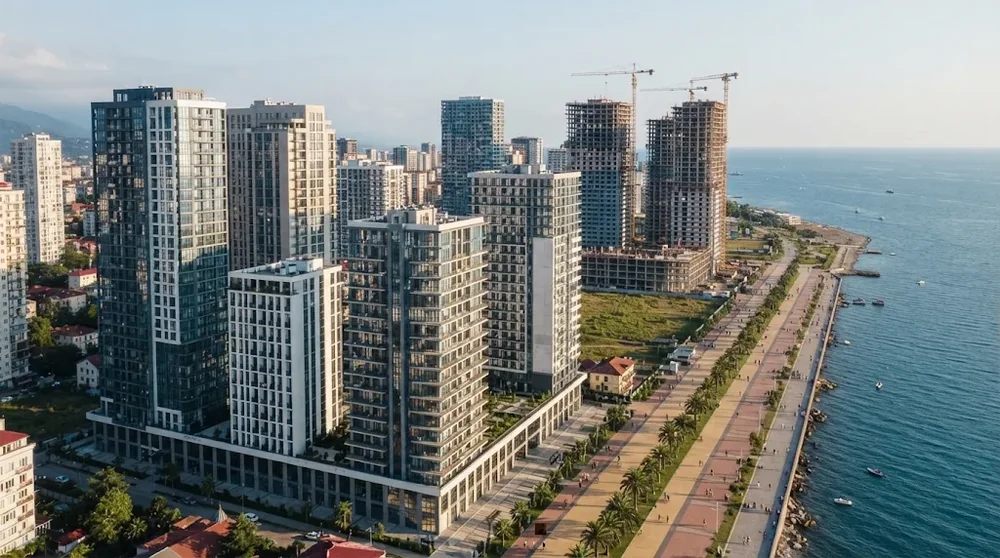
Batumi developers sell different products, and the differences matter more than the brand: conventional residences, aparthotels, internationally branded properties and announced masterplans carry different obligations. A finished, operating building is a different asset from a tower under construction, and both differ from a masterplan that exists as a presentation. Hotel partnerships and promised infrastructure are not delivery guarantees.
Batumi City and Seafront Projects
Alliance Group markets large residential and aparthotel-style complexes in Batumi, according to the company. ORBI Group is associated with aparthotel-style complexes, and some of its projects have been presented with hotel-operator arrangements. NEXT markets newer apartment and aparthotel-style schemes. Gumbati markets residential projects and planned schemes around the Batumi coast. All four descriptions are company-reported as of November 2026 and none has been independently audited here. Treat each as a marketed product until the acceptance documents are in your hands.
For a seafront building, the practical questions are different from those in Tbilisi. The coastal setting raises geotechnical and drainage questions, so ask for the engineering basis of the foundations and what the permit says about the structure. Large complexes also raise the question of what share of the units is owner-occupied, because that shapes the service charges and the building’s long-term upkeep. Ask who runs the building’s common areas today, and what the fee has been over the last three years.
Rental management exposure is the other Batumi-specific risk. A unit in an aparthotel-style complex may come with a rental programme, a management agreement or both. A rental programme is a contract with an operator, and its terms are separate from the purchase agreement. Read the fee split, the owner-use days, the exit terms and the consequences of the operator’s insolvency before you treat any quoted income as part of the price.
Gonio and Kvariati Developments
Gonio and Kvariati lie south of Batumi on the same coast but have a different character: quieter, less built up and more dependent on project-specific infrastructure. As of November 2026, Gonio and Kvariati form part of Batumi Municipality’s Gonio-Kvariati administrative district, according to the Batumi municipal legislation published on Matsne. A Batumi Municipal Council resolution dated 29 May 2026 concerning a development site in Gonio, also on Matsne, confirms Batumi municipal planning activity for the identified Gonio plots. It is a site-specific decision and does not by itself determine jurisdiction for every plot. The villages’ historical relationship with Khelvachauri does not establish their current permitting jurisdiction either. Verify the exact plot’s administrative jurisdiction and the competent permitting authority using its cadastral code and current municipal records, and confirm with your lawyer before relying on any single office.
A developer’s Batumi record says little about a Gonio or Kvariati scheme. Development maturity here is lower, and risk differs plot by plot, so do not assume one risk profile for the whole coast. Use this location checklist for each plot:
- Coastal and flood hazards: distance from the shoreline, erosion history, and whether the plot or access road floods after heavy rain.
- Slope and foundation conditions: ask for the geotechnical report, and whether the plot sits on or below a slope.
- Drainage: how surface water leaves the site and where it ends up.
- Wastewater disposal: connection to a sewer network or a septic or treatment solution, and who maintains it.
- Road access: public or private road, condition, and whether it is the access shown in the permit.
- Utility connections: written commitments from the utility providers for electricity, water and gas capacity, not a sales-team assurance.
- Funded versus announced infrastructure: amenities that are built or budgeted are different from amenities that appear only in renders.
In an area still being developed, you may be buying the first finished building next to several construction sites.
Branded Hotels, Master Plans and What They Do Not Guarantee
An international hotel brand does not guarantee that the builder will finish the project or that the unit will earn rental income. A trademark licence, a management agreement and a developer’s construction obligations are different legal relationships, and each may involve a different company. A developer’s announcement of a hotel partnership does not necessarily give apartment owners enforceable rights against the international hotel brand.
| Arrangement | Typical parties | What it usually covers | What it does not usually give a unit owner |
|---|---|---|---|
| Trademark licence | Brand owner and developer or owner company | Right to use the brand name on the building | No promise of income, completion or service standards to individual owners |
| Hotel management agreement | Property owner or operating company and the hotel operator | Running the hotel operations, fees and term | No direct rights for apartment buyers unless they are parties or named beneficiaries |
| Franchise agreement | Franchisor and franchisee | Brand standards and fees for the franchisee | No guarantee about unit occupancy or buyer returns |
| Commitment to unit owners | Developer or operator and each buyer | Only what is written in the signed contract with the owner | Anything that appears only in brochures or announcements |
Ask to see the operating agreement, who the parties are and whether owners can enforce any term. Master developers such as Eagle Hills are sometimes mentioned in connection with coastal projects. Treat any such announcement as a plan. Announced masterplans, delivered buildings and individually registered units are different stages. A registered, completed unit is ownership of existing property; a contract for a future unit is a contractual claim, and the two are not the same thing. That does not mean every earlier-stage interest is non-transferable or legally ineffective. Some may carry registrable or assignable rights. Which right you would actually hold, whether it can be registered and whether it can be transferred are questions for an independent Georgian lawyer, based on the contract in front of you. If a presentation shows a district, ask which plots are permitted, which are started and which units can be registered today.
How to Check a Developer’s Legal Records
You can verify a Georgian developer’s legal position in about twelve steps, and a foreign buyer can follow them with a local lawyer. The National Agency of Public Registry (NAPR) holds the company and property records, and the NAPR website is the primary source. The Code of Georgia on Spatial Planning, Architectural and Construction Activities, published on Matsne, the legislative gazette, governs permits and the acceptance of buildings into operation. Confirm the current consolidated version of the code before relying on any procedure; this guidance reflects November 2026.
- Get the exact legal entity. Ask for the full Georgian company name and identification number of the seller named in the reservation form. A brand name is not enough.
- Check the Registry of Entrepreneurs. Confirm the company is registered, who the directors and partners are and whether the registered status is active.
- Obtain the plot’s cadastral code. This is the unique land-parcel identifier used in the Public Registry. Every later check depends on it.
- Order the NAPR extract. The extract for the immovable property shows the registered owner, the area and any registered rights or restrictions.
- Ask for the documents behind the registered rights. An extract shows the result of a registration, not the contract underneath it. Ask your lawyer to request the supporting documents and to check later amendments to the record.
- Compare owner and seller, and check the seller’s authority. If the registered landowner is not the company selling to you, ask for the document linking them, such as a development agreement, and confirm that it authorises the seller to sell the proposed unit.
- Look for mortgages, seizures and restrictions. Encumbrances on the land are common in financed projects. A mortgage is not automatically a problem, but you need to know how it will be released and what happens to your unit.
- Request the building permit and approved design. Compare the permitted floor count, area and use with what is being advertised, and ask for any amendments.
- Check permit validity, extensions and amendments. Have your lawyer compare the original permit, its effective dates, any extensions, approved amendments and the current construction stage against the authority’s records. An expired permit, or an amendment that is still pending, changes what you can safely rely on. Do not rely on a proposed approval for anything affecting your unit until the legally required authorisation is confirmed.
- Verify the permit with the competent authority. In Tbilisi, the Tbilisi Architecture Service handles construction permits. For Batumi, including its Gonio-Kvariati district, confirm the competent body for the exact plot using its cadastral code. No single portal validates all locations.
- Confirm acceptance into operation. If a building is advertised as finished, ask for the document showing it has been accepted into operation, often called commissioning. A permit alone is not a building-completion certificate.
- Analyse your own right separately. Ask whether your intended right is already registrable, as an owned unit, or whether you are buying a contractual claim to a future apartment. They are different things. Have an independent Georgian lawyer review all of the above before you pay.
Registry extracts alone do not establish the enforceability of every contractual promise. They show what exists on paper on the day you check, so repeat the extract shortly before you sign, because registrations can change.
As of November 2026, NAPR lists online extract fees of 13 GEL within one working day and 52 GEL for same-day (filing-day) service. Non-online applications cost 20 GEL and 75 GEL respectively. An English-language version of a document may carry an additional fee, which can depend on the document type and the service requested, so ask NAPR what applies to your extract before ordering. These are document fees and are separate from the cost of registering ownership. NAPR’s published fees for registering ownership are 150 GEL for four working days, 270 GEL for one working day and 350 GEL for same-day processing, listed on the NAPR website under its fees pages. Fees change, so confirm them with NAPR before ordering.

Off-Plan Contracts: Deposits and Delivery Risks
An off-plan purchase agreement is the main source of buyer protection, and many of its weaknesses cannot be seen from the brochure. You pay in instalments for something that does not yet exist. Developer instalments are not the same as protected client funds: money you pay to a developer is usually the developer’s operating cash unless the contract says otherwise. Do not assume that escrow, bank guarantees or refunds apply automatically in Georgian off-plan purchases. Escrow, guarantees, milestone certification and stop-payment clauses depend on negotiation, contractual structure and legal enforceability. They are protections you ask for, not standards the law imposes on every developer.
Here’s the clause I always look for: the one that says what happens, step by step, if the handover date is missed. A buyer’s lawyer should inspect these items:
- Legal seller identity: the full company name and identification number, matching the Registry of Entrepreneurs.
- The designated apartment: floor, number and cadastral identification where available, not just a unit type.
- Floor-area calculation: whether the price is per square metre and whether balconies and common areas are counted.
- Finish definition: black frame, white frame or turnkey, with a written specification schedule.
- Construction milestones: stages tied to verifiable progress, with the instalment schedule linked to them.
- Handover deadline and grace periods: the exact date, permitted extensions and who decides whether an extension is justified.
- Late-delivery remedies: penalty rate, cap and whether you may terminate.
- Developer default and refund: deadlines for repayment, interest and what secures the refund.
- Buyer cancellation: what you forfeit if you withdraw.
- Dispute resolution: court or arbitration, and the governing law.
- Taxes and registration fees: who pays and when.
- Mortgage release: how any mortgage on the land is discharged and who bears the risk if it is not.
What Protection Mechanisms Actually Do
| Mechanism | Responsible party | Triggering event | Condition for payment or release | Remaining buyer exposure |
|---|---|---|---|---|
| Escrow | Independent escrow agent or bank | Agreed construction or registration milestone | Evidence of the milestone, as defined in the escrow terms | Disputes over whether the milestone was met; agent’s own terms |
| Independent bank guarantee | Issuing bank | Developer default or missed deadline as defined in the guarantee | A compliant demand by the beneficiary within the validity period | Guarantee amount, expiry date and exact wording of the trigger |
| Mortgage-release undertaking | Developer and the lender | Sale or registration of the unit | Lender’s written consent or release to be registered | Release may not happen if the developer or lender fails to act |
| Unsecured contractual refund promise | Developer only | Termination or default under the contract | Developer repays voluntarily, or the buyer wins in dispute resolution | Full exposure to the developer’s solvency and other creditors |
The existence and enforceability of each arrangement must be checked independently by a Georgian lawyer. A contract that mentions a guarantee is not proof that a guarantee has been issued; ask for the document. A guarantee that names another party as beneficiary, or expires before the date on which a default could realistically occur, may give a buyer very little. For any guarantee, check:
- Beneficiary identity: that you, the buyer, are the named beneficiary, not the developer or a third party.
- Guaranteed amount and scope: whether it covers all instalments paid or only part, and which obligations (refund, delivery, penalties) it secures.
- Issuing institution: the bank’s full name, and confirmation from the bank that the guarantee exists.
- Applicable law and expiry conditions: the governing law, the expiry date and whether it extends if construction is delayed.
- Demand procedure: who may claim, what documents the demand needs, the deadline and where it must be delivered.
For escrow, verify the account holder, who may give release instructions and on what evidence, and the circumstances in which funds are returned to you if a milestone is not met.
The scenario below is hypothetical. It does not represent any developer’s actual offer and is not a standard market schedule. Suppose a $120,000 apartment is paid in four stages: $24,000 at signing (20%), $36,000 over the first twelve months (30%), $36,000 at the frame stage (30%) and $24,000 at handover (20%).
- After twelve months you would have paid $60,000, which is half the price.
- If construction has reached only the foundations by then, your money is far ahead of the work.
- If the developer becomes unable to finish, your claim for repayment would depend on the contract, on any security for the refund and on the developer’s other creditors.
- If the land carries a mortgage, the lender’s rights may rank ahead of your contractual claim, which is why the release arrangements matter.
Insolvency outcomes depend on the precise contractual and registered rights you hold, so establish early whether your claim is secured, registered or unsecured. A registered right, a claim backed by a guarantee and a bare contractual refund promise sit in very different positions. Before making substantial advance payments, ask an independent Georgian lawyer to check the priority of your claim, whether any security is actually registered and what the practical recovery route would be.
A ‘0% instalment plan’ is a payment schedule. It is not a financing guarantee and it does not mean your money is held by a third party. The cost of the plan is often built into the price, so compare the total with a cash price.
The practical protection is to tie each instalment to a verified construction stage, and the contract should say how progress is certified. Ask for certification by an independent engineer or supervising technical expert named in the contract, not by the developer’s own statement. Add a stop-payment or suspension mechanism: if construction halts between milestones, or the developer materially breaches the contract, your next instalment is suspended until the issue is cured. These are conservative buyer-side asks, not statutory requirements, and a developer may refuse them, which is itself useful information. Terms like these are subject to independent legal review.
If you want a second pair of eyes on an off-plan contract before you sign, a short conversation about the specific clauses can save weeks of uncertainty later.
Send the draft agreement and the project’s cadastral code in your first message, and the discussion can focus on the clauses that matter. The reply will not replace a Georgian lawyer’s written review.
Construction Quality and Handover Checks
A building’s quality is established by looking at it, ideally with an engineer, and not by reading reviews. Visit the developer’s older completed buildings as well as the one you are buying into, and note what has aged badly. Keep three things apart: advertised completion, physical handover and official acceptance into operation. A building can be physically finished and handed over before the acceptance paperwork is complete, and the legal and practical consequences differ. The evidence matrix earlier in this article lists the document to request for each stage.
Use this checklist on an older building and again on your target building:
- Façades: cracking, staining, loose cladding and sealant failure at joints.
- Waterproofing: damp patches in basements and parking levels, roof terraces and balcony thresholds.
- Drainage: standing water on terraces, blocked gutters and how the courtyard drains after rain.
- Fire safety: ask for the fire-safety documentation, including commissioning records where they apply, and check that exits, alarms and stairwells are free and match the approved design.
- Elevators: that they work, how often they have failed and who services them.
- Ventilation: bathrooms, kitchens and the common stairwell, including signs of mould.
- Windows: seals, operation and condensation between glazing layers.
- Noise: airborne sound between flats and noise from lifts, pumps and traffic.
- Common areas: cleanliness, lighting and the condition of the entrance hall.
- Utility access: how water, electricity, gas and internet are connected and metered, who pays for connection, and written evidence that each connection has been commissioned.
- Frame specification: compare the delivered unit with the agreed schedule for finishes, wall condition and floor levels.
- Approved versus as-built plans: compare the approved design with the actual floor layout, and ask for the as-built documentation. Any material deviation in area, partitions, floor count or use needs a written explanation and, where relevant, an approved amendment.
- Snag-remediation schedule: a dated list of defects with the agreed repair deadline for each, signed by the developer, so that handover does not close the issue.
An independent engineer is worth paying for because they check items a buyer cannot judge, such as moisture readings, structural cracking and the compliance of installed systems. Ask the engineer at the start to mark which checks need specialist testing, for example electrical, gas, fire-alarm or waterproofing tests, so that you know what a visual inspection cannot confirm. The fee is small relative to the price of a flat.
Speak to residents, but treat their accounts as anecdotes. A few positive or negative reviews are not definitive proof of construction quality, because residents vary in expectations and in which defects they happened to meet. Look for patterns: the same problem reported by several unrelated owners is more informative than one detailed complaint.

Tbilisi Apartments vs Batumi Investment Properties
A Tbilisi apartment and a Batumi resort unit are different assets, and comparing their headline yields misleads. A Tbilisi apartment typically serves a resident tenant base, while many Batumi units depend on seasonal visitors. The table below lists the questions to answer for each before comparing returns, as general observations as of November 2026 and not as measured market data.
| Factor | Ordinary Tbilisi apartment | Batumi resort-oriented apartment |
|---|---|---|
| Tenant base | Residents, relocating households, long-let tenants | Holiday guests and short-stay visitors, plus some long lets |
| Seasonality | Generally less seasonal, but confirm for the district | Strongly seasonal; occupancy needs a stress test |
| Property management | Often self-managed or via an agent | Often an operator or management company under a contract |
| Furnishing | Usually the owner’s choice | May be specified or required by the operator |
| Service charges | Building maintenance fees; check the history | Can be higher and include facilities such as pools or lobbies |
| Operating expenses | Utilities, repairs, tax, agent fees | Management fee, cleaning, utilities, repairs, tax, platform fees |
| Rental restrictions | Usually few; check the building rules | May be tied to a programme with owner-use limits |
| Owner usage | Unrestricted in most cases | May be capped or charged under the operator agreement |
| Registered property classification | Normally a registered residential unit; confirm in the NAPR extract | An aparthotel marketing label does not establish the registered legal status; confirm how the unit is classified |
| Separate unit title | Check that your unit has its own registrable title | Confirm full apartment ownership versus a share or contractual right |
| Mandatory management | Generally none beyond the building’s common-area arrangements | May be compulsory under the operating agreement |
| Operating-agreement duration and termination | Not usually applicable | Read the term, renewal, termination rights and exit costs |
| Resale and owner-occupation restrictions | Depends on district and building quality | May be limited by the operator agreement; depends on the complex’s reputation, fees and buyer pool |
| Revenue-sharing terms | Not usually applicable | Must be read in the operating contract; do not rely on brochures |
A branded or hotel-managed investment property is a different thing from a private apartment in a building with a hotel name on it. In the first case an operator controls letting, pricing and often the unit’s use. In the second you are an ordinary owner who happens to share a lobby with a hotel. Ask which one you are buying, in writing.
Any yield scenario needs stated assumptions. The following is hypothetical arithmetic for a $100,000 unit and is not a forecast for Tbilisi or Batumi. Assume a gross annual rent of $7,000, a management fee of 25% ($1,750), service charges of $900 and other costs of $600. The operating income after those listed expenses would be $3,750, or 3.75% of the price. If gross rent fell by 20% to $5,600, the fee would be $1,400, costs would stay at $1,500 and the operating income would be $2,700, or 2.7%. These are illustrative operating figures, not fully comprehensive net investment returns. They exclude acquisition costs, applicable taxes, vacancy beyond the rent assumption, furnishing replacement and maintenance reserves. A total-return calculation should account for all of those, plus eventual disposal costs. The gap between gross rental income and income after operating expenses is why promotional yield figures need independent recalculation.
On market data, Geostat, Georgia’s national statistics office, published its Residential Property Price Index release for the third quarter of 2026 on 23 October 2026, with its methodology published on the same site. I do not quote its figures here, because they have not been independently re-checked for this article. The index covers new residential properties in Tbilisi, including flats and detached houses, and cannot be treated as a Batumi price index. It is constructed from advertised property information under Geostat’s published methodology, not from a comprehensive database of completed transactions. Do not mix it up with Batumi asking prices, registered transaction values or nationwide price measures. For Batumi, look for separately labelled sources with matching dates and definitions.
Developer Red Flags and a Buyer Decision Checklist
Most developer problems appear as paperwork gaps before they appear as construction problems. The table below sorts the common signals into green, amber and red and gives the next step for each. A green cell means that one condition is satisfactorily documented, not that the purchase is approved: the decision depends on the combined result of all checks. Amber means clarify or commission specialist review; red means pause the purchase until the issue is resolved in writing. The red and rejection rules in this section are conservative editorial risk controls. They are not statutory requirements, and they describe my own purchasing threshold, not a legal test.
| Signal | Green: condition satisfactorily documented | Amber: clarify or get specialist review | Red: pause |
|---|---|---|---|
| Contracting entity | Named seller matches the Registry of Entrepreneurs | Seller is a project company; ask how it relates to the brand | Seller cannot be identified |
| Land ownership | Registered owner is the seller or documented partner | Owner is a related party; request the linking agreement | Seller has no documented link to the landowner |
| Cadastral data | NAPR extract matches the brochure and contract | Minor discrepancies in area or plot number | Contradictory cadastral data that nobody explains |
| Mortgages and restrictions | None, or a release mechanism in the contract | Mortgage present; seek the lender’s release terms | Unexplained mortgage or seizure |
| Permit documentation | Permit and approved design provided and verified | Permit provided but amendments unclear | No permit evidence, or refusal to show it |
| Floor count and plans | Matches the permit | Differences explained by a pending amendment; do not pay against the changed plan until the authorisation is confirmed | Floors added or changed without documented approval |
| Access to records | Documents supplied promptly | Slow or partial replies | Refusal to provide records |
| Income claims | Illustrative, with assumptions shown | Quoted yield without cost detail | Implausible fixed or guaranteed income |
| Contract remedies | Clear delay penalty, refund timetable and termination right | Remedies exist but are capped or vague | Remedies are one-sided or absent |
A hypothetical comparison shows how the weighted framework works. Project A comes from a familiar brand, but the seller is a company you cannot link to the landowner, the NAPR extract shows a mortgage with no release plan and the sales team declines to share the permit. Project B comes from a lesser-known builder with a registered seller that owns the land, a clean extract, a verified permit and a contract with a stated refund timetable. The scores below are invented to demonstrate the method, describe no real company and do not rate any actual developer.
| Criterion (weight) | Project A score and evidence | Project B score and evidence |
|---|---|---|
| Completed-project evidence (25%) | Not rated: no building list supplied | 3: one accepted building traced by cadastral code |
| Project legality (25%) | 1: owner link missing, permit not shown | 4: extract and permit confirmed with authority |
| Financing and payment safeguards (20%) | Not rated: mortgage unresolved and no evidence of payment safeguards supplied | 3: milestone payments, release arrangement documented |
| Construction quality and aftercare (15%) | Not rated: no inspection possible | 3: older building inspected, defect terms written |
| Contractual fairness (15%) | 1: one-sided remedies | 3: stated refund timetable |
| Evidence confidence | C (lowest grade among the criteria weighted 20% or more) | A (lowest grade among the criteria weighted 20% or more) |
| Outcome | Insufficient evidence — not rated, because criteria weighted 20% or more have no evidence. Separately, the automatic rejection conditions below apply | Weighted total 65 of 100 (3.25 out of 5): (3 × 25 + 4 × 25 + 3 × 20 + 3 × 15 + 3 × 15) / 5 = 65. Proceeds to lawyer review; this is a screening result, not an approval |
Automatic rejection conditions sit outside the numerical score and apply regardless of score or brand reputation: a missing permit, an unprotected advance payment, or an unresolved mortgage-release arrangement. They are my own conservative risk controls, not legal standards, and a buyer with different circumstances and proper advice may reasonably set a different threshold. Project A fails on all three. Project B may still have price or quality issues, but its paperwork gives you something to negotiate with. Transparent paperwork can outweigh brand recognition.
From the deals I’ve handled, unresolved documents are rarely cured by reassurance; in the cases I remember, a promised “we will fix the paperwork after the deposit” did not shorten the delay. That is my observation, and the comparison above is hypothetical and describes no real company or buyer case.
Which Developer Should You Shortlist?
There is no single winner, because the right shortlist depends on what you are buying and how much paperwork you can obtain. The recommendations below are conditional, and each depends on the project’s documents. For each purchase type I give the decisive documents, the main risk and an editorial purchasing threshold, meaning the point at which I would stop. These thresholds are conservative buyer policies as of November 2026, not legal rules.
- Completed Tbilisi apartment: Archi, m², Axis or Domus projects are starting points once you hold the unit’s NAPR extract, the acceptance-into-operation document and an engineer’s inspection report. Decisive documents: the extract and the commissioning record. Main risk: hidden defects in a finished flat. Threshold: stop if the seller is not the registered owner or the acceptance document cannot be produced.
- Tbilisi off-plan residential purchase: the same four names are where research begins. Decisive documents: the permit, the landowner link, the mortgage release terms and the payment schedule. Main risk: payments running ahead of construction. Threshold: stop if instalments are not tied to certified milestones, or if the refund route is unsecured and you are not willing to carry that exposure.
- Completed Batumi holiday unit: compare finished buildings from Alliance Group, ORBI Group, NEXT and Gumbati on location, service charges and the building’s record. Decisive documents: the unit’s registered title and the service-charge history. Main risk: running costs for a unit that may sit empty. Threshold: for a buyer seeking immediate, separately registered ownership, do not proceed until that ownership is verified in a NAPR extract. A differently structured transaction, such as a share or a contractual right, is a separate product with its own risks, and a lawyer should assess it on its own terms.
- Managed Batumi investment: read the operating contract first and model operating income with the stress test shown earlier. Decisive documents: the operator agreement, its term and its termination rights. Main risk: relying on brochure income. Threshold: stop if owners have no enforceable rights or the operator’s obligations are unclear.
- Early-stage Gonio or Kvariati purchase: treat each plot separately and use the location checklist. Decisive documents: the permit and its issuing authority, the geotechnical report and written utility commitments. Main risk: announced infrastructure that is never built. Threshold: stop if the competent permitting authority cannot be confirmed or if access and utilities exist only in renders.
A short, document-based decision process works for each case:
- Identify the exact legal seller and verify it in the Registry of Entrepreneurs.
- Obtain the NAPR extract and the permit, and compare them with the contract.
- Have a Georgian lawyer review payment, delivery and refund clauses.
- Commission an engineer’s inspection of the target building or unit.
- Decide using the green, amber and red table, and walk away from reds.
A shortlist is only a starting point, and the buildings it produces still need the document checks described above before any money moves.
If you have a budget and a purpose in mind but no shortlist yet, a few short questions can narrow the field to projects worth checking.
If you already have a specific project in mind, you can request an independent review covering the legal entity, the NAPR documents, the permits, the payment schedule and the delivery clauses. Nothing has been reviewed for you in advance, and a review reports what the documents show; it does not promise an outcome.
Frequently Asked Questions About Georgian Developers
Who are the most reliable property developers in Georgia?
Archi, m², Axis and Domus in Tbilisi, and Alliance Group, ORBI Group, NEXT and Gumbati in Batumi, are widely marketed names worth investigating. No developer deserves blanket certification from its brand alone, because safety varies by project. Judge each building on verified completions, land ownership, permits, encumbrances and the actual purchase agreement, ideally with an independent Georgian lawyer.
How do I verify a developer in Tbilisi or Batumi?
Start with the developer’s exact legal name and identification number in the Registry of Entrepreneurs, held by NAPR. Then order a NAPR extract for the land using its cadastral code, and confirm the building permit with the competent authority: the Tbilisi Architecture Service in Tbilisi, or the competent Batumi municipal body for Batumi and its Gonio-Kvariati district. Check owner, mortgages, permit scope and the contracting company before paying.
Is buying an off-plan apartment in Georgia safe?
An off-plan purchase can be reasonable, but the buyer carries construction delay, specification change and developer-default risk. Safety depends on the specific project’s land and permit records, its financing and the enforceable terms of the contract. Obtain independent legal advice, and make sure instalments, deadlines, cancellation rights and refund obligations are written down. Do not assume escrow or guarantees exist.
What happens if a Georgian developer delays construction?
Your remedies depend on the signed agreement and applicable Georgian law, not on automatic compensation. The contract may provide a grace period, delay penalties, termination rights or refund procedures, or it may say very little. A Georgian lawyer should read the handover deadline, permitted extensions, penalty wording, refund timetable and dispute-resolution clause before you sign.
Are branded residences in Batumi safer investments than ordinary apartments?
Not automatically. A hotel brand can shape positioning and management expectations, but it does not guarantee construction completion, rental income or resale liquidity. Verify the developer’s legal obligations, the actual management or brand agreement, the ownership structure, operating fees and rental restrictions. Then compare realistic operating-income scenarios against an ordinary apartment instead of relying on promotional yield projections.
Final Verdict: Shortlist Documents, Not Brands
The short answer: the developers named here are legitimate places to start, but a name is not a safety check. Archi, m², Axis and Domus in Tbilisi and Alliance Group, ORBI Group, NEXT and Gumbati in Batumi each need the same scrutiny of the project’s seller, land, permit, encumbrances and contract. The evidence in this article is partial by design, and the table says ‘Not independently verified’ wherever I could not stand behind a claim.
Check this before you sign — here’s why: verified records, enforceable contractual protections and independent professional advice can materially reduce avoidable purchase risks, although they cannot eliminate construction or developer-default risk. A clean extract, a verified permit and clear delay and refund clauses count for more than a famous logo, and they are far harder to repair after the money has moved. My own view, which is opinion and not a finding, is that most avoidable losses come from skipping a check because the brand felt familiar.
The decision sequence: verify the seller, the land, the permit and the registered rights; examine how your payments are safeguarded; obtain independent legal and engineering review; and reject any material risk that remains unresolved in writing.
Disclaimer: this article offers general property research as of November 2026 and is not individual legal, financial or engineering advice. Fees, rules and market conditions change, so confirm current details with the relevant authority. Consult an independent Georgian lawyer and a qualified surveyor or engineer before committing funds.