

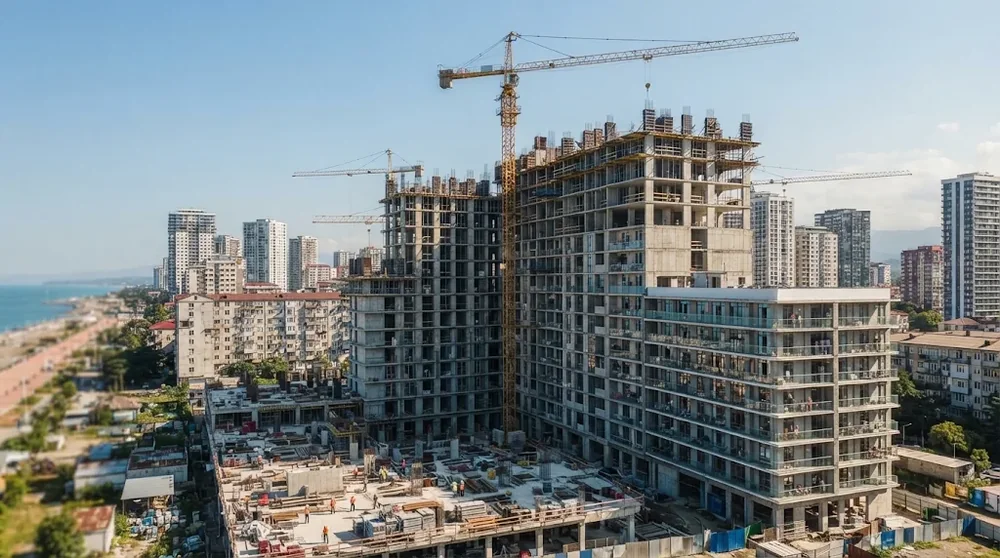
Picture a buyer in Batumi holding two offers for similar apartments. One asks for 20% now and 36 monthly payments. The other asks for a smaller deposit but a large final payment at handover. Neither headline shows how much cash must leave the buyer’s account on each date, or what the keys will cost once registration, currency conversion and fit-out are added. This guide lays out the whole sequence as of November 2026.
Georgia property payment plans vary by developer, with down payments often advertised around 10–30% in selected developer offers and instalments often extending through construction. Some projects offer lower deposits or longer terms. Buyers should also budget for Public Registry fees, legal checks, currency conversion and property finishing. Compare total payable amounts and ownership-registration terms before signing.

How Property Payments Work in Georgia
A Georgian property purchase is paid in one of three ways: a single cash payment, a developer instalment agreement or a bank mortgage. The question that matters is how much cash must be available on each date, not what the advertised apartment price says. From the deals I’ve handled, buyers who plan around the price alone are usually surprised by the timing.
Cash, instalments and mortgages compared
In a cash purchase, the buyer pays the agreed price, usually in one or two transfers, and registration follows. In a developer instalment agreement, the price is split into a down payment and scheduled payments that may run through construction and sometimes beyond handover. In a mortgage, a bank lends part of the price and the buyer funds the rest. Mortgage eligibility for non-residents depends on each bank’s own policy, so cash purchase versus mortgage is a decision to take with the lender’s written terms in hand.
Resale and off-plan follow different schedules
A resale apartment in Tbilisi normally has a short sequence: a negotiated reservation deposit, a purchase agreement, payment of the balance and registration of ownership with the National Agency of Public Registry (NAPR). An off-plan apartment has a longer one: reservation, contract, a series of payments linked to dates or construction milestones, handover and then title registration. The stages can occur in a different order, and some developers register earlier than others. The table shows the typical sequence as a planning tool, not as a legal rule.
| Stage and timing | Recipient | Typical obligation | Evidence to keep | Main risk |
|---|---|---|---|---|
| Reservation (day 0) | Seller or developer | Small fixed sum, or a percentage | Written reservation terms | Refundability unclear |
| Contract signing (days 1–14) | Seller or developer | Down payment, often credited to the price | Signed contract and receipt | Paying before checking title |
| Scheduled payments (months 1–36) | Account named in the contract | Monthly, quarterly or milestone payments | Payment calendar and bank advice | Wrong recipient, late-payment penalties |
| Handover (end of build) | Developer | Final or balloon payment | Acceptance act with specification | Delay or unfinished condition |
| Registration (after handover or sale) | NAPR | Registration fee in GEL | Registry extract showing the buyer | Title not yet in the buyer’s name |
Signing, paying and registering are three separate moments
In a resale, the buyer’s real exposure sits in the gap between transferring the price and seeing the registry entry change. Signing the agreement fixes the terms. Transferring the price moves your money. Registration at NAPR is what puts your name on the title. If the money leaves first and the registration stalls, you are relying on the seller’s good faith and on whatever the contract says about that gap.
NAPR offers a Smart Contract service, which is designed to coordinate the settlement and the registration so that they happen in a linked way. It is not automatic payment protection, and it is not suitable for every transaction. Ask your lawyer, or the relevant service provider, whether a coordinated settlement mechanism fits your deal, who sets it up and what it costs, before you agree to pay the balance in a single unprotected transfer. The same logic applies to cash buyers: the shorter the gap between payment and registration, the smaller the exposure.
The sections below follow the money in the order it moves, from reservation to registration, and then past the keys.
Down Payments and Reservation Deposits
A reservation fee, a deposit credited to the price and a down payment are three different payments, even when sellers use the words interchangeably. Each one carries its own refund conditions, and those conditions sit in the contract, not in the marketing.
Reservation, deposit and down payment
A reservation fee takes the apartment off the market for a stated period, often a few days to two weeks. A deposit credited against the price is a prepayment that reduces the balance. A contractual down payment is the first formal instalment under the instalment agreement, typically paid when the contract is signed. Check four points in writing: whether the sum is refundable, the date by which the contract must be signed, whether the apartment is held exclusively for you and what happens if the developer withdraws the unit.
What published down-payment figures actually show
As of November 2026, published sources describe developer down payments in different ways. Korter describes a range of 0–40%. Garant Group says some offers start at 10–20%. GeCoast reported 10–25% in a selection of catalogue entries it reviewed in October 2026. Other local guides describe 20–30%. These are examples drawn from identified, differently composed selections of offers. They are not statutory rates, and they are not a national average or a representative statistic. Offers change with the project, the unit and the sales campaign, so any figure you rely on must be reconfirmed in the developer’s written quotation, dated and tied to a named project.
The table shows what a deposit looks like at three illustrative percentages on three hypothetical prices. The prices are assumptions for calculation only.
| Property price (USD) | 10% deposit (USD) | 20% deposit (USD) | 30% deposit (USD) |
|---|---|---|---|
| 80,000 | 8,000 | 16,000 | 24,000 |
| 100,000 | 10,000 | 20,000 | 30,000 |
| 150,000 | 15,000 | 30,000 | 45,000 |
The mistake I see buyers make most often: treating a low deposit as a sign of a safer deal, or a high one as a sign of a better developer. Deposit size alone is a poor safety measure. A 10% deposit with a clean title, a clear refund clause and a registered right can be a stronger position than 30% paid into an account with no refund terms. A larger deposit mainly means more money exposed earlier.
Developer Instalment Plans: Terms and Total Cost
A developer instalment plan splits the price into payments over time, and its real cost is the difference between the instalment price and the cash price for the same apartment. An advertised 0% rate does not mean the two prices are equal.
How the payments are structured
Plans commonly use monthly or quarterly payments, construction-linked milestones, or a deferred final balance. Some continue after handover. Durations of 24, 36 and 48 months appear in this article as illustrative structures, not as guaranteed standard products. Compared with a bank mortgage, a developer plan usually has less formal underwriting and a fixed schedule set by the contract, but it also lacks the regulated disclosures a lender provides, and the buyer’s recourse is whatever the contract says.
The price premium behind a 0% plan
Take a hypothetical apartment with a cash price of USD 100,000 and an instalment price of USD 105,000. The absolute premium is USD 5,000, equal to 5% of the cash price. That is a total premium, not an annual rate. To turn it into an annual figure you need a defined schedule, so here is one that you can reproduce.
Assumptions: the buyer pays USD 20,000 at signing and the remaining USD 85,000 of the instalment price in equal monthly payments. Against the cash price, the amount financed is USD 80,000 (USD 100,000 less the USD 20,000 deposit). Over 36 months the payment is USD 2,361.11. The implicit monthly rate is the one at which the present value of those 36 payments equals USD 80,000, found by an internal-rate-of-return calculation (in a spreadsheet, the RATE function with 36 periods, a payment of 2,361.11 and a present value of 80,000).
| Term (equal monthly payments) | Monthly payment (USD) | Implicit nominal annual rate (approx.) | Effective annual rate (approx.) |
|---|---|---|---|
| 12 months | 7,083.33 | 11.4% | 12.0% |
| 36 months | 2,361.11 | 4.0% | 4.1% |
| 48 months | 1,770.83 | 3.0% | 3.0% |
The nominal figure is the monthly rate multiplied by twelve. The effective figure compounds it. Both are rounded, both rest on the schedule above, and neither is an official APR. A different deposit or an uneven schedule will move them, so use them as a method and not as a quote.
| Item | Cash purchase | Instalment plan |
|---|---|---|
| Contract price (hypothetical) | USD 100,000 | USD 105,000 |
| Difference | Base | USD 5,000 (5% of cash price) |
| Cash needed at signing | Full price or agreed stage | Down payment only |
| Opportunity cost | Funds tied up from day one | Funds remain available but are committed to a calendar |
| Early settlement | Not applicable | Depends on contract; may or may not reduce the price |
The comparison leaves out registration fees, fit-out and currency effects, which apply to both routes. The terms that decide the outcome are early settlement, acceleration clauses, which let the developer demand the whole balance after a default, and any payment-holiday provisions.
Here’s the clause I always look for: the one that says what happens to the unpaid balance if you pay early. Some contracts reduce the remaining price, others only shorten the calendar. Ask which one yours is before you commit to a premium.
The comparison that matters is two written quotations for the same apartment, one for cash and one for instalments, with every payment date listed. A template for that request appears near the end of this guide.
Worked Example: A $100,000 Apartment
The following schedules are fictional and use USD 100,000 as a round number. They do not describe a real developer or project.
Scenario A: 20% down and 36 equal payments
The balance after a 20% deposit is USD 80,000, and 36 payments produce approximately USD 2,222.22 a month. Thirty-five payments of USD 2,222.22 total USD 77,777.70, so the 36th payment is USD 2,222.30 to reconcile the price exactly.
Assumptions: contract price USD 100,000; deposit USD 20,000 at signing; no interest or surcharge within the stated price; payments due monthly; handover assumed at the end of month 36; all amounts in USD before conversion.
| Period | Payment (USD) | Cumulative paid (USD) |
|---|---|---|
| Month 0 (signing) | 20,000.00 | 20,000.00 |
| Months 1–12 | 26,666.64 | 46,666.64 |
| Months 13–24 | 26,666.64 | 73,333.28 |
| Months 25–36 | 26,666.72 | 100,000.00 |
| Completion and registration | No further price payment; GEL fees apply | 100,000.00 |
Scenario B: lower monthly payments with a handover balloon
Assumptions: price USD 100,000; deposit USD 20,000 at signing; 24 monthly payments of USD 2,000, which is USD 48,000; and a single balloon payment of USD 32,000 due once, at handover, assumed at the end of month 24. The balloon is a separate one-off payment and is not a 25th monthly instalment. The total is USD 100,000. Monthly cost is lower than in Scenario A (USD 2,000 against USD 2,222.22), but USD 32,000 must be available on a single date, and that date can move if construction slips.
| Period | Payment (USD) | Cumulative paid (USD) |
|---|---|---|
| Month 0 (signing) | 20,000 | 20,000 |
| Months 1–12 (12 × 2,000) | 24,000 | 44,000 |
| Months 13–24 (12 × 2,000) | 24,000 | 68,000 |
| Handover, end of month 24 (one-off balloon) | 32,000 | 100,000 |
| Registration | No further price payment; GEL fees apply | 100,000 |
The GEL ledger
Registration and registry fees are paid in GEL, so they sit in a separate ledger. As of November 2026, the official NAPR ownership-registration fee is GEL 150 in four working days, GEL 270 in one working day or GEL 350 on the day of application, as listed on the NAPR fee schedule. A registry extract is GEL 13 online or GEL 20 for the standard service, and signature confirmation is GEL 7 when applicable.
| Item (GEL) | Amount | Status |
|---|---|---|
| Ownership registration, standard | GEL 150 | Official NAPR tariff, November 2026 |
| Registry extract | GEL 13 online / GEL 20 standard | Official NAPR tariff, November 2026 |
| Signature confirmation | GEL 7 | When applicable |
| Legal review, translation, bank charges, agency fee, fit-out | Individually quoted | No fixed amount assumed |
Read the totals with care. GEL 163 is only the sum of one standard ownership registration (GEL 150) and one standard online extract (GEL 13). Fast registration with a standard extract totals GEL 370. NAPR publishes separate fees for other services and registrations, for example expedited extracts, English-language extracts, cadastral plans and the registration of additional rights or obligations such as a mortgage. Not every buyer will need these, and the list is not exhaustive, so confirm which ones your transaction triggers. USD and GEL figures cannot be added without an exchange-rate assumption and a date, because the rate moves. The currency section below shows how.

Georgia Property Closing Costs Explained
Georgia has no separate general transfer tax or stamp duty on property purchases, so the closing costs consist of registry fees plus whichever services the transaction uses. As of November 2026, the main official charge is the NAPR registration fee of GEL 150, GEL 270 or GEL 350, depending on speed.
The official charges
The National Agency of Public Registry publishes its tariffs, and registration is typically handled through the Public Service Hall or other NAPR service channels. Some competing guides quote GEL 157 as the standard registration fee. That is not the official figure for the services listed here, and a buyer should rely on the current NAPR schedule instead. The procedure for registration is set by the Law of Georgia on Public Registry, available through the Legislative Herald of Georgia.
The first table holds only officially published fees. The second holds charges that depend on the services you choose and on private agreements.
| Officially published NAPR service | Amount | Nature | Who normally arranges or pays, subject to agreement |
|---|---|---|---|
| Ownership registration (4 working days) | GEL 150 | Standard service fee; needed to register title | Buyer, unless the contract says otherwise |
| Ownership registration (1 working day) | GEL 270 | Optional faster service | Buyer |
| Ownership registration (same day) | GEL 350 | Optional faster service | Buyer |
| Registry extract | GEL 13 online / GEL 20 standard | Standard service fee; strongly advisable | Buyer |
| Signature confirmation | GEL 7 | Triggered when the service is requested | Party requesting it |
| Privately agreed or quoted item | Amount or basis | Nature | Who normally arranges or pays, subject to agreement |
|---|---|---|---|
| Notarial certification | Individually quoted | Not automatically mandatory | Per agreement |
| Lawyer’s due diligence | Individually quoted | Optional but advisable | Party who hires the lawyer |
| Translation and interpreter | Individually quoted | Needed if documents are not understood | Buyer |
| Power of attorney | Individually quoted | Only if buying remotely | Grantor |
| Valuation and bank charges | Individually quoted | Mortgage-related | Borrower |
| Agency commission | Per agreement | Optional | Seller or buyer, as written in the agency terms |
| Developer administrative charges | Per contract | Contract-dependent | Per contract |
Who actually pays
Contractual allocation and legal liability are different questions. A column that says who normally pays describes habit, not obligation. The contract can move a cost from one side to the other, and the law may in some cases set the responsible party regardless of what the parties prefer. Where nothing is written, the party who requests a service usually bears its fee.
A concrete example: the seller engages an agency and agrees in writing to pay its commission, while the buyer appoints an independent lawyer and pays that lawyer’s fee. The agency commission is then a seller cost and the legal fee is a buyer cost, although both relate to the same apartment. The reverse arrangement is just as common, so agree the split in writing before the first payment. Developers may add administrative or contract-preparation charges, which should appear in the quotation and not surface at signing.
Notarisation, VAT and later taxes
Notarial certification is not automatically required for every standard transaction. Whether a notary is needed depends on the transaction type and the parties, so a Georgian property lawyer should confirm the requirement for the specific deal.
No general transfer tax is a different matter from VAT. The general Georgian VAT rate is 18%, set under the Tax Code of Georgia, which also contains specific exemptions, including provisions on land and certain residential-property transactions (Article 171 is the provision to ask your adviser about). Whether VAT applies depends on the actual supplier, the asset and the transaction. It is wrong to assume that every new build carries an extra 18% at closing, and equally wrong to assume that every residential sale is exempt.
The practical verification procedure has three steps. Ask the seller or developer to state in writing whether the quoted price includes VAT. Ask whether the seller treats the supply as taxable or exempt. Have your tax adviser or lawyer check that answer against the Tax Code and, where needed, the Revenue Service. Seller-side taxes, and later property, rental and resale taxes, are separate from closing costs.
Check this before you sign — here’s why: a quotation that says “price” without saying “VAT included” leaves an open question worth a very large number. Ask for the sentence in writing.
A percentage-based closing-cost estimate is not universal. Because the biggest items, lawyers, translation and agency terms, are individually priced, the honest approach is a line-by-line quotation.
Off-Plan Contracts and Ownership Protection
Signing a contract, paying money and registering title are three different events. Registered ownership requires the appropriate right to be recorded with the Public Registry, and payment alone does not create it. That distinction is the centre of off-plan risk.
What can be registered, and what cannot be assumed
Three things get confused here, and they are not the same. Registered ownership is the title itself. A registered obligation relating to ownership is an entry that records a binding commitment about the property, such as a duty to transfer it. An ordinary contractual promise is only a promise between two parties and appears nowhere in the registry. Article 11 of the Law of Georgia on Public Registry sets out the categories of rights and, in specified cases, obligations relating to immovable property that can be entered in the register. Whether your preliminary agreement falls into one of those categories is a question about its form and the project’s registration status, and not every preliminary agreement is independently registrable. The Civil Code of Georgia, available on Matsne, governs the underlying contract and transfer rules.
Registering an obligation is not necessarily equivalent to registering ownership, and it does not by itself give priority over an existing mortgage. Registration also cannot guarantee that construction will finish or that money will be returned. Ask an independent Georgian lawyer for a project-specific examination of three things: the cadastral records of the plot, the registration instrument offered to you and the security arrangements already recorded against the land. Information is as of November 2026, and the texts should be checked in their current consolidated versions.
Land, mortgages and releases
Many projects are built on land that is itself mortgaged to a lender. This is not unusual, but the buyer needs to know whether the developer must obtain a release of individual apartments on completion, who gives it and on what conditions. If the developer defaults, a registered mortgage over the land can rank ahead of an unregistered buyer’s claim. A registry extract shows the owner, the cadastral identifier, mortgages and liens at the date it was issued, not at the date of the next payment.
Due-diligence checklist
- Obtain a current registry extract for the plot and identify the owner and the cadastral code.
- Check that the seller or developer named in the contract is the registered owner or holds a documented right.
- Look for mortgages, liens, seizures and other encumbrances on the land.
- Obtain the construction permit and confirm that its scope matches the building you are buying.
- Ask for the release mechanism for individual apartments from any land mortgage.
- Ask whether the apartment’s right or obligation can be registered before handover, under which instrument and at whose cost.
- Match the apartment area, number and floor in the contract to the project drawings.
- Confirm the exact payment account, and that it belongs to the contracting developer.
- Have a Georgian lawyer review the draft before any substantial payment.
Stop-signs include a seller who will not show the registry extract, a payment request to a personal account, a contract with no delivery date and a refusal to describe the release of a mortgage. None of these proves wrongdoing, but each one justifies pausing the payment.
A legal check can change the outcome of a purchase, and a short review before you sign usually costs far less than one after a dispute starts.
If you want a second pair of eyes on a draft contract or a registry extract before you commit funds, you can send the documents and your questions for a one-to-one review.
A review like that sits alongside, and does not replace, independent legal advice from a licensed Georgian lawyer.

Currency Conversion and Overseas Transfers
A USD quotation, the contract’s currency clause, the currency the law permits for settlement and the actual bank transfer are four separate things. An apartment advertised in USD does not by itself tell you which currency the contract requires, or which currency the law allows for that payment.
What to verify
Article 34 of the Organic Law of Georgia on the National Bank of Georgia establishes the lari as legal tender and contains a general requirement for entrepreneurs to advertise property prices in lari, subject to applicable regulatory exceptions. That is a rule about advertising. It is not the same as the currency in which the debt is denominated, and neither is the same as the currency in which a payment may lawfully be settled. Article 383 of the Civil Code adds that obligations in foreign currency may be agreed unless the law prohibits it. So a USD-denominated contract can be possible, while the legality of the actual payment arrangement still has to be checked against the exceptions and the rules published by the National Bank of Georgia. As of November 2026, confirm this with a Georgian lawyer and the receiving bank before assuming any currency.
Then settle four points in the contract:
- The currency in which each payment is due.
- The rate source used for any conversion.
- The fixing date for that rate.
- Who bears the bank charges.
An illustrative sensitivity calculation
Hypothetical assumptions for November 2026: an instalment of USD 20,000 and an exchange rate of GEL 2.70 per USD, so the instalment equals GEL 54,000. If the lari weakens by 5% against the dollar to GEL 2.835 per USD, a buyer who earns in GEL needs GEL 56,700 for the same USD 20,000, an extra GEL 2,700. If the payment is fixed in GEL under the contract, the exchange-rate risk shifts toward the developer, which is one reason developers resist that clause. The numbers are hypothetical and not a forecast.
Fees add up
Assume a 0.5% bank spread and a USD 30 flat transfer fee, both hypothetical. On a USD 2,222.22 monthly payment, that is about USD 41.11 a month, or roughly USD 1,480 over 36 payments. Sending banks, intermediary banks and receiving banks may each charge, so ask which party covers them. The mistake that costs real money is sending funds to a personal account that is not named in the contract. Verify every payment instruction by calling the developer on a number you obtained independently, not one from the email that carries the instruction. International transfers may also need supporting documents such as the contract, so keep copies.
Payment Terms in Tbilisi and Batumi
A Tbilisi resale, a Batumi off-plan apartment and a coastal new build in Gonio or Kvariati are three different transactions with different payment shapes. This section describes the structure of each, and quotes no district averages because none can be verified.
| Transaction | Typical payment shape | Main risks | What to confirm |
|---|---|---|---|
| Tbilisi resale | Negotiated reservation deposit, balance at transfer | Encumbrances, undisclosed debts, price negotiation | Extract, utilities, who pays which fee |
| Batumi off-plan | Down payment, staged or monthly payments, handover balance | Delivery delay, specification changes, land mortgage | Delivery date, release mechanism, refund terms |
| Gonio or Kvariati new build | Developer plan, sometimes with deferred balance | Completion, management obligations, rental-programme terms | Finish level, service charges, tourist-apartment terms |
To see how the same price produces different cash calls, here is a clearly hypothetical comparison. All three purchases cost USD 100,000. The schedules are illustrations, not regional market averages.
| Timing (hypothetical) | Tbilisi resale | Batumi construction-stage purchase | Gonio or Kvariati developer plan |
|---|---|---|---|
| Day 0, reservation | USD 2,000 | USD 1,000 | USD 1,000 |
| Contract signing | USD 98,000 balance at signing and registration | USD 29,000 (30,000 in total so far) | USD 19,000 (20,000 in total so far) |
| During construction | None | 18 monthly payments of USD 2,500 (USD 45,000) | 24 monthly payments of USD 2,500 (USD 60,000) |
| Handover | Keys at registration | USD 25,000 balloon | None; end of month 24 |
| After handover | None | None | USD 20,000 deferred balance, months 25–36 |
| Total price payments | USD 100,000 | USD 100,000 | USD 100,000 |
| Where the exposure sits | Title and encumbrances at the moment of payment | Delivery date, land mortgage, balloon timing | Completion, specification, post-handover obligations |
These rows are local structure observations, not offer-specific facts. Where a developer’s project is quoted, the project name, deposit, term and observation date should all be stated, and in this article no project is quoted because none has been verified for November 2026. Developer terms change and must be reconfirmed in writing before any payment. In coastal projects, ask whether the apartment comes with a management or rental-pool obligation, because that affects both cost and use.
If you are still choosing between a city resale and a coastal new build, a short questionnaire on your budget, preferred location and goals can narrow the list to properties that fit your payment capacity.
A shortlist is only a starting point. Each property still needs its own payment schedule and its own document check before any deposit moves.
Costs After Handover and Registration
Construction completion does not end the buyer’s spending. Handover can be the start of the largest single block of costs, namely fit-out and furnishing.
Black frame, white frame and finished
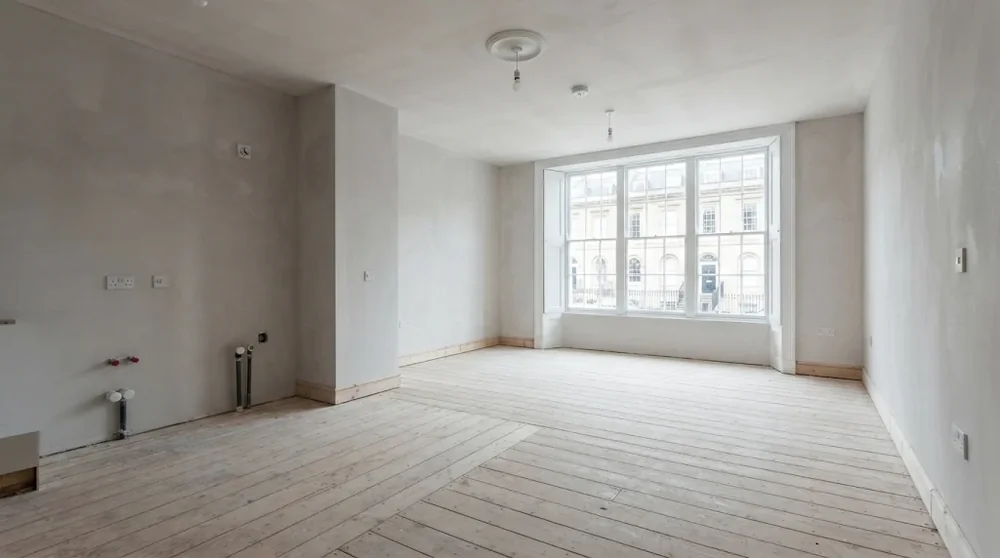
Black frame usually means bare concrete walls and floors with basic services roughed in. White frame usually means plastered walls and a more advanced base, ready for finishes. A fully finished apartment may include flooring, bathrooms and doors, and sometimes furniture. These labels are commercial descriptions, not legal categories, and the exact specification must be written into the contract or an annex. Without it, two apartments with the same label can differ by thousands of dollars of work.
The first-year budget
Ask the developer for a separate fit-out quotation, or get an independent one, and build a first-year budget alongside the purchase schedule. Annual personal property tax in Georgia depends on the household-income threshold, the property category and the current Tax Code, so verify the November 2026 rules with the Georgian Revenue Service instead of relying on older figures. Rental income taxation, if you let the apartment, is separate again.
The table below is a blank worksheet. Copy it into a spreadsheet and fill each row only from a written quotation or a contract clause. Where you have no supported price, leave the cell empty; an invented average is worse than a gap.
| Cost | Estimated amount | Contractual amount | Due date | Payment currency | Evidence or quotation |
|---|---|---|---|---|---|
| Fit-out and finishes | |||||
| Kitchen, appliances, furniture | |||||
| Snagging and defect correction | |||||
| Utility connections | |||||
| Management and service charges | |||||
| Insurance (building and contents) | |||||
| Property and rental taxes |
Do not assume that completion means the apartment is ready to occupy. Insist on an inspection before accepting the apartment and sign the acceptance act only after the snagging list is recorded.
Missed Payments, Delays and Contract Exit
The consequences of a missed payment, a developer delay or an exit depend on the signed agreement and on applicable Georgian law. Treat every protective clause below as a negotiation target and not as an automatic legal right. Whether a specific clause is enforceable requires review by a qualified lawyer.
Buyer default and developer default side by side
| Topic | If the buyer is late | If the developer is late |
|---|---|---|
| Penalty | Late-payment interest or a fixed fee, if the contract says so | Contractual compensation, and any remedies available under applicable Georgian law |
| Grace period | May exist; often short | May exist for delivery; check length |
| Notice | Default notice before termination, if required | Buyer’s written notice, if required |
| Acceleration | Developer may demand the full balance | Not applicable |
| Termination and refund | Retention of some or all paid amounts, per contract | Refund terms and timing, per contract |
| Payment suspension | Usually not allowed unless stated | Check whether buyer may pause payments |
Ask a Georgian lawyer to assess termination rights, damages, notice requirements, the proportionality of penalties and the enforceability of refund restrictions under the relevant Civil Code provisions. A penalty clause that looks harsh on paper is not always enforceable in full, and a protection that looks generous may be narrower than it reads.
Twelve clauses to check
- The payment calendar, with exact dates and amounts.
- The currency and exchange-rate clause.
- The late-payment penalty and how it is calculated.
- The grace period before a default arises.
- The notice procedure before termination.
- Whether the whole balance can be accelerated after a default.
- The delivery milestone date and any permitted extension.
- The remedy for delayed delivery, including refund timing.
- The refund mechanism on termination and the account it comes from.
- Early-payment terms and any price reduction.
- Assignment or resale of the contract before completion, and any developer fee.
- Dispute-resolution forum and governing law.
Assignment before completion, where the buyer transfers the contract to another person, may require developer consent and may carry a fee, so ask before you count on it as an exit. From the deals I’ve handled, the clauses buyers most often skip are the ones about delivery delay and refund timing, which are exactly the ones they need if something goes wrong.
Read the default, delay and refund clauses side by side, and test them with a simple scenario: what happens, in euros or dollars and in calendar days, if the developer delivers six months late, and what happens if you miss one instalment by three weeks. If the contract cannot answer both questions in plain terms, treat that as a finding, and take it to your lawyer before the next payment.
Compare Two Offers Before Paying a Deposit
The only reliable way to compare two apartments is a single worksheet with the same rows for both. Compare the total amount payable and the cash needed on each date, not the headline price. The example below uses two hypothetical offers, and every figure is an assumption.
This table compares two distinct hypothetical purchase offers. It is not a controlled cash-versus-instalment comparison of the same apartment: Offer A is a black-frame unit and Offer B is a white-frame unit, so the USD 5,000 headline difference cannot be attributed to financing alone. The same-unit financing premium is analysed in the instalment section above.
| Row | Offer A (hypothetical) | Offer B (hypothetical) |
|---|---|---|
| Contract price | USD 100,000 | USD 105,000 |
| Reservation fee and refundability | To be confirmed in writing | To be confirmed in writing |
| Initial cash | USD 20,000 | USD 10,500 |
| Monthly cost | USD 2,222.22 for 36 months | USD 2,000 for 24 months |
| Final or balloon payment | None | USD 46,500 at handover |
| Total payable (contract price) | USD 100,000 | USD 105,000 |
| VAT included in price? | Confirm in writing | Confirm in writing |
| Registration fees (GEL) | GEL 150 + extract, November 2026 | GEL 150 + extract, November 2026 |
| Foreign-exchange and bank costs | Estimate from your bank | Estimate from your bank |
| Finish level | Black frame | White frame |
| Estimated fit-out cost to reach the same finish | Independent quotation needed | Independent quotation needed |
| Outstanding liabilities at handover | Balance due: none | Balance due: balloon USD 46,500 |
| Completion deadline | Stated in contract | Stated in contract |
| Contractual protections | Per review | Per review |
Offer B reconciles as follows: USD 10,500 + 24 × USD 2,000 (USD 48,000) + USD 46,500 = USD 105,000. The worksheet exposes a trap. Offer B costs USD 5,000 more on paper and defers a large payment into one date, while Offer A asks for more cash on day one. But Offer A still needs more fit-out spending to reach the finish Offer B already has, so no total-cost conclusion is possible until both fit-out rows are filled from quotations. Neither is better in the abstract. It depends on your cash flow, the contract terms and the completion risk.
A reusable quotation-request template
Send the same request to every seller and developer, and fill one copy per offer. Do not pay a deposit until you hold a written, property-specific payment schedule that answers every line.
| Field to request | Your entry |
|---|---|
| Cash price (for the same unit) | |
| Instalment price | |
| Reservation fee, and whether it is refundable | |
| Deposit or down payment, and its due date | |
| Each scheduled payment: amount and date | |
| Balloon amount and expected date | |
| VAT: included or not, and taxable or exempt treatment | |
| Registration costs (GEL) | |
| Bank and currency-conversion costs | |
| Fit-out cost to the specified finish | |
| Management and service charges | |
| Delivery date and permitted extension | |
| Registered right or obligation, and the instrument used | |
| Refund provisions on termination or delay |
Total payable = price (cash or instalment) + VAT if not included + registration and extract fees + bank and conversion costs + legal and translation fees + fit-out and furniture + first-year management, insurance and taxes. Convert GEL items at a stated rate and date.
A chronological checklist
- Request the written offer, with every payment date and amount.
- Review the registry extract for the land and the unit.
- Verify the developer’s identity and its right to sell.
- Obtain both the cash price and the instalment price in writing.
- Review the full contract, not only the summary.
- Verify the transfer instructions by an independent call.
- Reserve funds for registration and closing costs in GEL.
- Schedule an independent legal review before the first substantial payment.
If you would like to compare real offers in this format, you can request a property-specific payment schedule, a written total-cost estimate and a contract review for an apartment in Tbilisi, Batumi, Gonio or Kvariati. The review supports your decision and does not guarantee any outcome, and it does not replace advice from a Georgian property lawyer, tax adviser or bank.
Frequently Asked Questions
How much deposit do I need to buy property in Georgia?
There is no universal down-payment percentage for buying property in Georgia. Developer offers are often advertised with deposits around 10–30%, but published projects also advertise zero deposits or higher requirements. A resale purchase may use a separately negotiated reservation deposit. Always check whether the amount is refundable, when the remaining balance is due and what happens if the transaction falls through.
Can foreigners buy an apartment in Georgia in instalments?
Foreign buyers can generally purchase eligible residential apartments in Georgia through developer instalment agreements without first obtaining a residence permit. However, financing terms are set by individual developers, and payment plans are not guaranteed to every applicant. Check the contract, the property’s legal status, payment currency, registration conditions and any applicable ownership restrictions before transferring money.
Are interest-free property instalments in Georgia really free?
An advertised 0% instalment plan does not necessarily mean that its total price equals the cash price. A developer may charge more for the same apartment under a deferred-payment agreement or offer a discount for immediate payment. Request both written quotations and compare the total contracted amount, payment dates, additional fees and early-settlement provisions before deciding.
What closing costs should I budget for in Georgia?
As of November 2026, official ownership-registration fees are GEL 150, 270 or 350, depending on the processing speed. Georgia has no separate general transfer tax or stamp duty. Buyers may also need legal assistance, translation, bank services or a notary. The actual total depends on the agreement, the property and which optional services are required.
When do I become the owner of an off-plan apartment in Georgia?
Paying a reservation deposit or signing an instalment agreement does not automatically make you the registered owner. Ownership depends on the legal transaction and registration of the appropriate right with Georgia’s Public Registry. Some off-plan buyers can register a preliminary right or an obligation relating to ownership, which is not the same as registered title. A Georgian property lawyer should verify the registration mechanism before the first substantial payment.
What happens if I miss a developer instalment payment?
The consequences depend on the signed instalment agreement and applicable Georgian law. A missed payment may trigger a grace period, contractual penalties, a default notice or termination procedures. The developer’s right to retain payments or demand the balance must be checked against the contract and law. Review these clauses, including refund terms, before signing.
Key Takeaways Before You Pay
The short answer: a Georgia property payment plan is a calendar of cash needs, and its real cost is the total payable plus registration, conversion and fit-out. As of November 2026, the official NAPR registration fee is GEL 150, GEL 270 or GEL 350, and Georgia has no general transfer tax or stamp duty. The larger and more variable costs are the instalment premium, currency movement and the finish of the apartment.
The longer answer is that the contract decides most outcomes. Deposit percentages vary by project and are not rules. Registered title is a separate event from payment, and a registered obligation is not the same as registered ownership. Delivery, refund and default clauses are the ones to read twice. My own view, offered as opinion and not as legal advice, is that a written side-by-side of two offers, checked by an independent lawyer, is the most useful step a buyer can take before the first deposit.
This article reflects a November 2026 research baseline drawn from NAPR publications, Georgian legislation and tax and central-bank information, together with dated commercial observations from developers and agencies. Published terms, fees and regulations may change, and worked examples are illustrative and not offers. This is general information, not legal, tax or financial advice. Obtain individual advice from a qualified Georgian property lawyer, a tax adviser and a banking professional before committing funds.