Batumi apartment quotes are hard to compare because developers, agents and research houses rarely price the same thing. One quote covers a black-frame shell on an instalment plan. Another covers a furnished turnkey unit with the balcony counted in full. District averages are useful only once you know what they measure, when they were observed and how far a particular apartment departs from them.
Batumi property prices by district vary substantially: Galt & Taggart’s June 2026 primary-market turnkey averages were US$3,239/m² in Old Batumi, US$1,800/m² in New Boulevard and US$2,228/m² for Gonio–Kvariati combined. Use these as benchmarks, then compare each apartment’s completion stage, floor area, view, access and total purchase cost.

Batumi Property Prices by District: The Benchmark
| Statistical location | June 2026 price (US$/m²) | Price basis | 2Q26 registered sales: primary and secondary combined |
|---|---|---|---|
| Old Batumi | 3,239 | Primary market, turnkey | 349 |
| New Boulevard | 1,800 | Primary market, turnkey | 1,664 |
| Gonio–Kvariati (combined category) | 2,228 | Primary market, turnkey | 83 |
The short answer: as of June 2026, the Old Batumi category carried the highest primary-market turnkey benchmark of the three locations compared here, while New Boulevard was lowest and Gonio–Kvariati combined sat between them. The longer answer: these figures describe research categories, not the price of any particular apartment.
Keep two dates and two scopes apart. The prices are June 2026 observations for new turnkey apartments. The sales counts cover the whole of the second quarter of 2026 and combine primary and secondary registrations. A quarterly count of registered sales is evidence of registered activity across both markets, not a measure of developer sales alone and not a measure of how quickly a given flat sells today.
For context, Galt & Taggart’s annual Batumi residential report for 2025, published 6 March 2026, gave December 2025 turnkey benchmarks (district-price figure on page 9) of US$3,028/m² for Old Batumi, US$1,761/m² for New Boulevard and US$2,048/m² for Gonio–Kvariati. On that equivalent basis, the June 2026 figures were higher in all three categories. Six months of movement in a research average describes the past; it is not a forecast, and it says nothing about whether an individual apartment has appreciated.
Four kinds of price evidence circulate in Batumi, and they should not be mixed: research benchmarks such as these turnkey averages; advertised starting prices, which usually describe the cheapest unit in the least finished state; asking prices for specific listings; and registered transaction evidence held by the National Agency of Public Registry (NAPR). Registered evidence shows that a transaction was registered and, where available, the contractual price declared to the registry. That makes it stronger than an asking price, but it is not the same as independently verified payment evidence, and it arrives with a lag.
A district benchmark is a reference point for negotiation, not a valuation.
What These District Prices Actually Measure
The Galt & Taggart prices above are primary-market benchmarks: they track new apartments sold by developers, not resales between private owners. The secondary market — existing flats resold by individuals — has its own pricing, often shaped by age, condition and how urgently the seller needs to exit. A primary-market average should not be used to price a twenty-year-old resale, and the reverse holds too.
Finish matters as much as location. In Batumi, black frame normally means a structural shell with little or no internal work; white frame usually adds plastered walls, screed and basic utility connections; turnkey means a finished apartment ready for furniture or occupation, sometimes furnished. The label alone does not establish what you will receive: the written specification attached to the contract does. A turnkey research category also does not prove that every building in the sample is completed and operational.
Advertised “from” prices are a separate animal again. A headline starting price is typically a single unit — low floor, poor outlook, earliest construction stage — and does not represent the average apartment in a project, let alone the district.
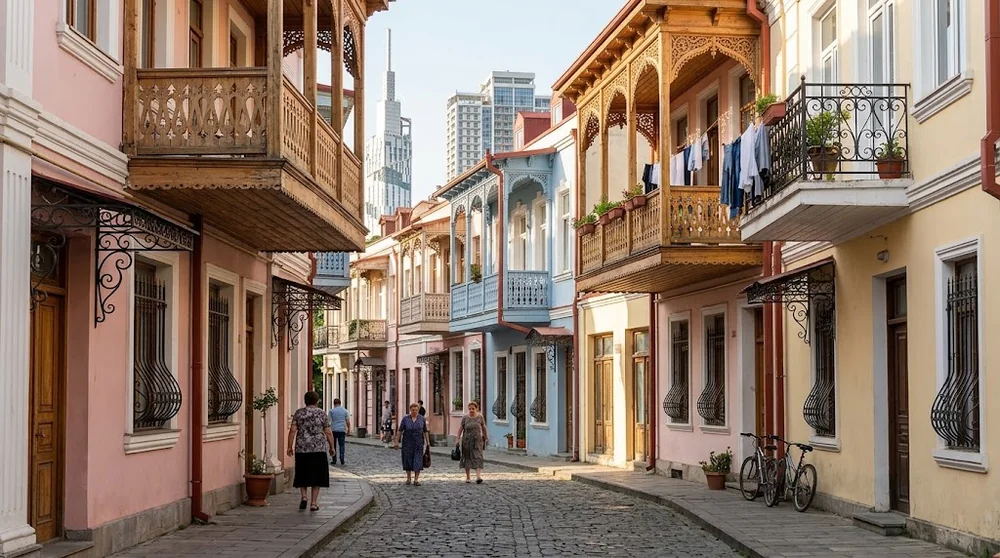
Boundaries need equal care. Old Batumi is a report category; Old Town is an everyday description of the historic core. As I read the report’s location map, Old Batumi covers the older central grid around the port and the original seaside boulevard; New Boulevard covers the newer coastal strip running south from the centre towards the airport; and Gonio–Kvariati covers the coastal settlements south of the Chorokhi river towards the Sarpi border.
These three are not the whole city. The report also publishes separate categories — Alley of Heroes, Inner Areas and Peripheral Zones — that are not covered in this comparison. A modern building near the coast is not automatically New Boulevard: it may fall into Alley of Heroes or an inner-area category instead. The published map does not give street-by-street boundaries, so use it for approximate assignment only, and where an address sits near an edge — particularly where the old centre meets the newer southern districts — flag it as uncertain rather than forcing it into the nearest named category.
The practical rule follows from that. Assign each address you compare to one research category, write down why, and use the same assignment for every quote and comparable in your sample. Do not let one agent call a building “Old Town” and another call its neighbour “New Boulevard” and then compare both against different benchmarks.
Finally, primary-sale registration with NAPR can lag the underlying purchase, sometimes until a building is completed. Quarterly transaction counts therefore reflect registrations, not current sales velocity.
Old Town Batumi: Understanding the Price Premium
The Old Batumi premium is a statistical result for a category of new turnkey apartments, not a price tag for any particular historic building, and a premium address does not establish construction quality or rental performance.
Historic Stock Versus Modern Apartments
The centre contains two quite different products. Older residential buildings may offer character, high ceilings and established streets, but their condition, shared areas and documentation vary enormously. Newer apartment buildings within the central area typically offer lifts, modern services and clearer specifications, and they are the stock most likely to resemble a primary-market turnkey benchmark. Comparing a renovated flat in an old building with a new turnkey unit on a per-square-metre basis will mislead unless condition and specification are adjusted.
Development rules for individual central plots should be checked plot by plot with the relevant authorities and a Georgian lawyer; do not rely on general assumptions about what can or cannot be built nearby.
Street-Level Checks
- Walkability and services: confirm year-round shops, pharmacies, clinics and transport within a realistic walk, not just in season.
- Noise: visit in the evening and at weekends; bars, restaurants and through-traffic can change a street’s character.
- Parking: establish whether a space is owned, leased or simply unavailable.
- Common areas: inspect stairwells, roofs, façades and lifts, and ask who maintains them and how costs are shared.
- Alterations: where a flat has been extended, combined or reconfigured, compare the physical layout with the NAPR record and any approvals.
Central convenience is real, but it has to be tested address by address rather than assumed from the district name.
New Boulevard: Lower Benchmark, Wider Choice
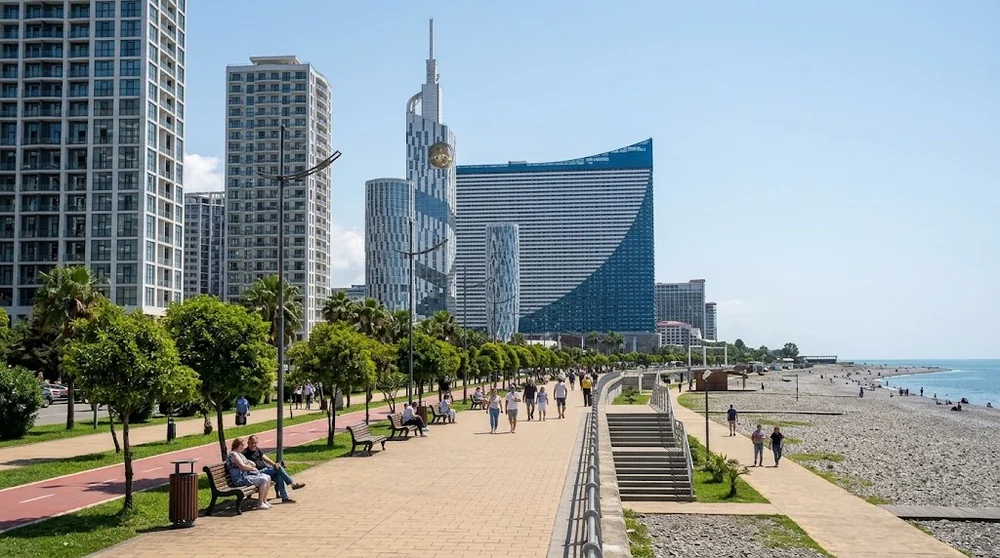
New Boulevard had the lowest benchmark of the three categories and by far the highest 2Q26 registration count. That points to a large volume of registered activity and a broad spread of products, but because the count mixes new and resale registrations, it cannot on its own show how big the primary market is or how strong developer demand is.
Address matters within the corridor. A first-line tower facing the sea, an internal block behind it and a building further along the southern stretch can sit in the same statistical category while offering different outlooks, walking routes and future competition. I would not attach a fixed premium to any of these positions without a matched, dated sample; the differences are real, but their size depends on the building.
The practical checks are mostly about how a tower functions:
Count the lifts against the number of apartments and floors, and ask what happens during maintenance. Look at density: dozens of units per floor change the experience of corridors, lobbies and the beach in summer. Check adjacent plots for current or future construction that could affect light, noise or views. Walk the actual route to the beach, including road crossings. Read the service-charge terms and any building rules on owner use, short-term letting or mandatory management.
The mistake I see buyers make most often: treating a high district transaction count as proof that their own studio will resell quickly. The same supply that creates the volume also creates the competition.
Distinguish permanent residential use from hospitality operations. Some buildings are designed and run as aparthotels, with management agreements, revenue-sharing and restrictions on personal use. That model can suit a passive investor, but it is a different product from a flat you live in, and it should be valued and contracted as such.
Gonio Property Prices: Assess the Exact Address
Galt & Taggart does not publish a separate Gonio average in the 2Q26 report. Gonio and Kvariati share one statistical category, and that combined benchmark should not be read as a Gonio-specific price.
Practically, Gonio deserves its own assessment because its addresses differ sharply. Beach-side buildings and inland plots offer different daily routines; some coastal projects require crossing the main coastal road to reach the shore, which matters for families and for short-term guests carrying luggage. Ask exactly how residents reach the beach and how long the walk takes.
Construction phasing is the second issue. Where a project is delivered in stages, request its phasing plan in writing: a completed first block may sit next to an active building site for some time, and you should consider how that affects noise, access and letting.
Third, test winter practicality. Check which shops, pharmacies and restaurants stay open out of season, how frequent public transport is to central Batumi, and how roads and drainage behave in heavy rain.
A low advertised entry price does not make the completed product cheaper. Compare the finish, stage and total cost before concluding that an outlying address represents better value than a central one.
Kvariati Property Prices: Access, Elevation and Views
Kvariati sits in the same combined category, so the report does not show whether it is more or less expensive than Gonio. I have no matched sample that would justify claiming a premium, a discount, greater quiet or better liquidity for either settlement.
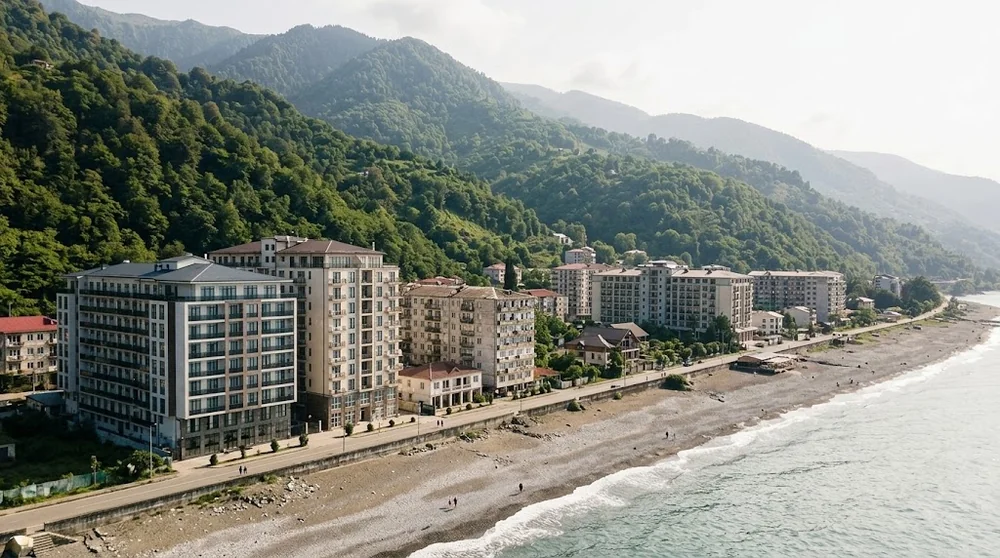
What can be assessed is the address itself. Kvariati combines buildings near the shore with projects on the green slopes behind it, and elevation changes the practical picture considerably:
Access and gradient. A hillside apartment may have a striking outlook but a steep walk back from the beach. Walk the route yourself, ideally carrying something, and consider older relatives or guests.
Parking and roads. Confirm where cars park, how the access road is maintained and how it copes in wet weather.
Drainage. Slopes channel water. Ask about drainage design, retaining structures and any history of water ingress, and include this in a technical inspection.
Winter convenience. As with Gonio, check year-round services and transport to the city before relying on off-season occupation.
Views require particular caution. Before paying for a sea view, ask a Georgian lawyer to assess the planning permissions around the building and whether any enforceable restriction limits development on neighbouring plots. A marketing promise, or a developer’s statement in the contract, should not be treated as protection against what may be built next door.
Compare Apartment Quotes on the Same Basis
A price per square metre is only meaningful when every quote uses the same basis. Run each apartment through the same sequence:
- Exact address: building, block and unit number, matched against the NAPR record or the developer’s documentation, and assigned to one research category.
- Completion stage: off-plan, under construction or completed; and, if completed, whether the building is operational.
- Area definition: saleable area versus internal living area, and how the contract measures each.
- Balcony treatment: whether balconies and terraces are counted at full area, partly or not at all.
- Finish inventory: black frame, white frame or turnkey, with a written list of what is installed.
- Furniture and appliances: included, optional or excluded, with an itemised list.
- Outlook: sea, mountain, city or courtyard, and what neighbouring plots may change.
- Floor: height, lift access and exposure.
- Payment schedule: lump sum or instalments, triggers and any price difference for paying upfront.
- Service obligations: service charges, management contracts and any mandatory operator.
Here is a hypothetical example of why the area definition matters. An apartment priced at US$90,000 with 50 m² of saleable area works out at US$90,000 ÷ 50 = US$1,800 per saleable m². If those 50 m² include a 10 m² balcony, dividing by the 40 m² of internal space gives US$90,000 ÷ 40 = US$2,250 per internal m². The apartment and price are identical; only the denominator has changed.
Normalising quotes to internal area is a comparison aid. It does not replace the contractual area definition, which governs what you are buying and how any area adjustment is calculated.
Here’s the clause I always look for: the area-adjustment provision. It should say how the final area will be measured at handover, what tolerance applies and how the price changes if the measured area differs.
Turn District Benchmarks into a Purchase Budget
The benchmarks become more useful once converted into money. The table below applies the June 2026 turnkey benchmarks to a hypothetical 50 m² apartment. These are arithmetic illustrations, not available listings and not total budgets.
| Statistical location | Benchmark (US$/m², June 2026) | Hypothetical area | Purchase-only sum (US$) |
|---|---|---|---|
| Old Batumi | 3,239 | 50 m² | 161,950 |
| New Boulevard | 1,800 | 50 m² | 90,000 |
| Gonio–Kvariati (combined category) | 2,228 | 50 m² | 111,400 |
A real budget adds costs that sit outside the purchase price. Obtain written quotations for each rather than applying a universal percentage:
- Legal review: an independent Georgian lawyer to check title, the contract and project documents.
- Translation: certified translation of contracts and powers of attorney where you need them.
- Technical inspection: a suitable inspector for completed or nearly completed buildings.
- NAPR registration: as of October 2026, 150 GEL for registration within four working days, 270 GEL within one working day and 350 GEL on the day of application; recheck the current tariff before filing.
- Excluded fit-out or furniture: only where the specification excludes them. A turnkey example already includes finishing, so do not add fit-out a second time; add furniture only if it is not supplied.
- Banking and currency conversion: transfer fees, conversion spreads and any account-related charges.
- Initial service charges: any advance payments or set-up fees required by the building or manager.
- Contingency: a reserve for delays, minor defects or price adjustments under the area clause.
Property benchmarks are quoted in US dollars, while official fees are set in GEL. For an indicative conversion, use a dated official rate published by the National Bank of Georgia (NBG) and note the date. Treat that figure as a reference benchmark only: the money you actually spend depends on the conversion rate your bank quotes on the day, its spread and its transfer fees, so build the purchase budget on the bank’s written quote rather than the official rate.
The difference between the three illustrative sums is large — over US$70,000 between Old Batumi and New Boulevard at the same floor area. That gap is the starting point for deciding what you are actually paying for.
Choose a District for Living, Letting and Resale
The right location depends on use. This matrix keeps Gonio and Kvariati separate because it is a qualitative decision tool, not a set of price statistics. The entries are practical checks from my own viewings, not findings from a dated project sample.
| Location | Year-round practicality | Holiday-use checks | Operating-cost questions | Resale competition |
|---|---|---|---|---|
| Old Town | Often strong where services are established; confirm noise and parking | Distance to beach, guest access, building rules | Shared-area maintenance in older buildings; who pays for façade or roof work | Depends heavily on building condition and documentation |
| New Boulevard | Varies by tower; check lifts, winter occupancy and nearby services | Beach route, management terms, permitted letting | Service charges, lift maintenance, operator fees | Count similar modern units, especially studios, in the same and neighbouring towers |
| Gonio | Test off-season shops, transport and road conditions | Road crossings to beach, seasonality of demand | Management availability, travel costs for repairs | Where a project is phased, ask how many units later stages will add |
| Kvariati | Test gradients, parking and winter access | Walking route from hillside to shore, guest mobility | Drainage maintenance, access-road upkeep | Check comparable new projects nearby; view depends on neighbouring plots |
Net letting performance is the rent you actually receive after vacancies, management fees, service charges, utilities, cleaning, repairs, taxes and furnishing replacement. All of those vary by apartment and season, which is why I do not assign yields to districts. A well-run unit in a modest location can outperform a poorly managed one at a premium address, and the reverse is equally possible.
For resale, think about what a future buyer will be able to choose from on the same street.
Check the Quoted Price Before You Sign
Check this before you sign — here’s why. A benchmark tells you whether a quote looks plausible; only a matched comparable sample, documents and an inspection tell you whether it is fair for that unit.
A Repeatable Fair-Value Test
From the deals I’ve handled, the buyers who negotiate well are the ones who can show their working. This is the sequence I use, and it can be repeated for any quotation:
- Date the sample. Record the date you collect each comparable, and keep the window short so that market movement does not distort the comparison.
- Collect several genuinely comparable units. Same research category, same completion stage, similar finish, floor band, outlook and size. Two or three convenient listings are not a sample.
- Remove duplicates. The same apartment often appears through several agents at different prices; keep one entry per unit, identified by building and unit number.
- Label the evidence type. Mark each comparable as an asking price, a developer price list or registered transaction evidence, and do not average them together as if they were the same thing.
- Normalise area and specification. Convert every price to the same area basis, note balcony treatment, and record differences in finish, furniture and payment terms rather than guessing a percentage for each.
- Document the difference. Write down, in plain terms, why the target quotation sits above or below the sample — a higher floor, a protected-looking but unprotected view, an instalment premium. If you cannot explain the gap, that is the question to put to the seller.
Documents and Inspection
- Request a full written cost sheet covering price, payment schedule, service charges and any optional extras.
- Check ownership and encumbrances, such as mortgages or seizures, in the National Agency of Public Registry (NAPR) extract.
- Verify project documentation, including construction permits and the developer’s right to the plot.
- Commission a technical inspection of the unit and common areas.
- Review neighbouring plots for planned or permitted development.
- Have the contract reviewed, focusing on clause types covering area adjustments, the handover specification, completion dates and delay remedies, payment triggers, service charges, management arrangements and any resale or assignment restrictions.
Those clause types are review topics, not a statement that any particular contract contains them or that they are enforceable as drafted. Current legislation is published on Matsne, the official legislative portal, but interpretation should come from an independent Georgian lawyer, with a suitable technical inspector for the building itself.
If a specific contract or quotation raises questions — an unclear area definition, a payment trigger or a management clause — a short one-to-one discussion before signing can save an expensive correction later.
Whichever route you take, keep every answer in writing. Verbal assurances about views, completion dates or included furniture carry little weight once a dispute arises.
Frequently Asked Questions About Batumi District Prices
Which Batumi district has the most expensive property?
Old Batumi had the highest benchmark among the locations compared here: US$3,239 per square metre for primary-market turnkey apartments in June 2026, according to Galt & Taggart. That is a research category covering the older central area around the port and seaside boulevard rather than one historic street, and the report does not publish its exact street boundaries. A particular apartment’s value still depends on its building, condition, floor area, outlook and contractual specification.
Is New Boulevard cheaper than Old Town Batumi?
The June 2026 primary-market turnkey benchmark was US$1,800 per square metre in New Boulevard, compared with US$3,239 in the Old Batumi category. This supports a lower district-level benchmark, not a universal rule for every listing. A premium waterfront apartment in New Boulevard can cost more than an older or less desirable apartment in the centre.
Are apartments in Gonio cheaper than in Kvariati?
Galt & Taggart’s 2Q26 report combines Gonio and Kvariati, giving a June 2026 primary-market turnkey benchmark of US$2,228 per square metre. It does not establish which settlement is cheaper. Compare separate, dated samples with matching completion stages, finishes, views and access before drawing a conclusion about the price difference between them.
What does the price per square metre include in Batumi?
The advertised price per square metre does not establish a standard specification. Check whether the apartment is black frame, white frame or turnkey, whether furniture and appliances are included, and how balconies enter the quoted area. Request a written inventory and area definition. Compare purchase prices using the same finish, completion stage and floor-area basis.
Which Batumi district suits year-round living or holiday letting?
Established central streets can suit buyers prioritising walkability and year-round services, while New Boulevard offers a broad choice of modern coastal apartments. Gonio and Kvariati require closer checks on transport, winter services and seasonal demand. For holiday letting, evaluate the exact building, beach route, management terms and competing units rather than selecting a district from its name alone.
How much should I budget beyond the advertised apartment price?
Add legal review, translation where needed, inspection, registration, banking and currency-conversion costs, initial service charges and a contingency. Include fit-out and furniture only when the purchase specification excludes them. Obtain written quotations rather than applying one universal percentage. The total depends on the property’s condition, completion stage, contract and the services required for your transaction.
Conclusion
The district benchmarks tell you where to start, not where to buy. As of June 2026, the reported primary-market turnkey averages were roughly US$1,800/m² in New Boulevard, US$2,228/m² in Gonio–Kvariati combined and US$3,239/m² in Old Batumi, according to Galt & Taggart. Those are district averages, not matched apartment quotations. The sensible sequence is to decide on use first, set a total budget that includes every additional cost, normalise each quotation to the same area and finish basis, test it against a dated comparable sample, and then inspect the exact address.
In my view, many poor purchases in Batumi come from comparing headline numbers that were never comparable in the first place. A shortlist built on matched specifications reduces those comparison errors; title, construction, contract and operating risks still need their own checks.
If you share your total budget, intended use, preferred completion stage and location priorities, you can receive a shortlist of comparable apartments assessed on the same basis.
A shortlist is a starting point for due diligence, not a substitute for it; each address should still go through the document, inspection and contract checks described above.
This article provides general information as of October 2026 and is not legal, tax or investment advice. Market figures are research benchmarks, not valuations, and past price movements do not predict future results. Consult an independent Georgian lawyer, a qualified technical inspector and a tax adviser about your specific transaction.